Mineral recovery plants still leave valuable material in their tailings. Many rely on reactive adjustments made hours after assay results arrive, which widens the gap between how the circuit runs and what the ore body could deliver.
Energy prices, reagent bills and skilled-labor shortages continue to climb. Unplanned circuit changes increase chemical use, and each shift change risks drifting from the previous setpoints. With ore bodies growing more complex and regulatory pressure increasing, the status quo strains both margin and sustainability targets.
AI in mineral processing addresses these pressures through five methods that build on one another. Each aims at stable throughput, lower cost and higher critical-mineral recovery.
1. Predict process conditions before they are needed
A predictive model learns from plant data and live sensor feeds to detect ore-quality shifts minutes or hours before they upset recovery. Trained on many operating scenarios, it calculates the next setpoint for mill speed, reagent dosage or air flow and sends it to the distributed control system (DCS) before drift takes hold.
That turns the wait-and-correct routine into anticipation, with smoother throughput and fewer emergency adjustments. A simulation environment lets engineers test what-if scenarios offline, then take the best strategy to the plant with confidence.
2. Optimize several process variables together
Mineral circuits are often tuned one variable at a time: pH in the lab, air flow at the cell, reagent dosage when results slip. Multivariable optimization adjusts pH, temperature, air flow and reagent dosing together, and keeps adjusting them as ore chemistry shifts.
Because the model learns how a change in one variable ripples through flotation, leaching and purification, it can search many setpoint combinations and choose the one that maximizes margin at current market conditions. It applies the predictive insight from the method above across all of the variables at once.
The payoff depends on data discipline: synchronized sensors, reliable assays and clear validation cycles. Perfect data is not required to start. Rolling optimization out circuit by circuit lets operators build trust while the model keeps learning, and it gives plant-wide visibility in place of isolated adjustments.
3. Adapt to ore characteristics in real time
When ore chemistry varies widely, static setpoints leave recovery behind. Sensors on conveyors and loading equipment can analyze incoming material in real time, and models learn the signatures of valuable mineral, waste and moisture content.
Real-time classification can send high-grade material to the right circuit and divert waste before it affects downstream operations. The same ore data feeds the multivariable adjustments described above. Compared with assays that arrive hours later, immediate feedback keeps recovery steadier, cuts downtime for recalibration and supports feed blending for better mineral liberation.
Sensor calibration and reliable data streams remain essential. Poorly maintained analyzers or measurement drift degrade model accuracy and limit what adaptive control can achieve.
4. Use less reagent while recovering more
Reagents are a major cost in any flotation circuit, and most plants dose them with generous safety margins to absorb ore variability. Model-based dosing can take the place of that buffer.
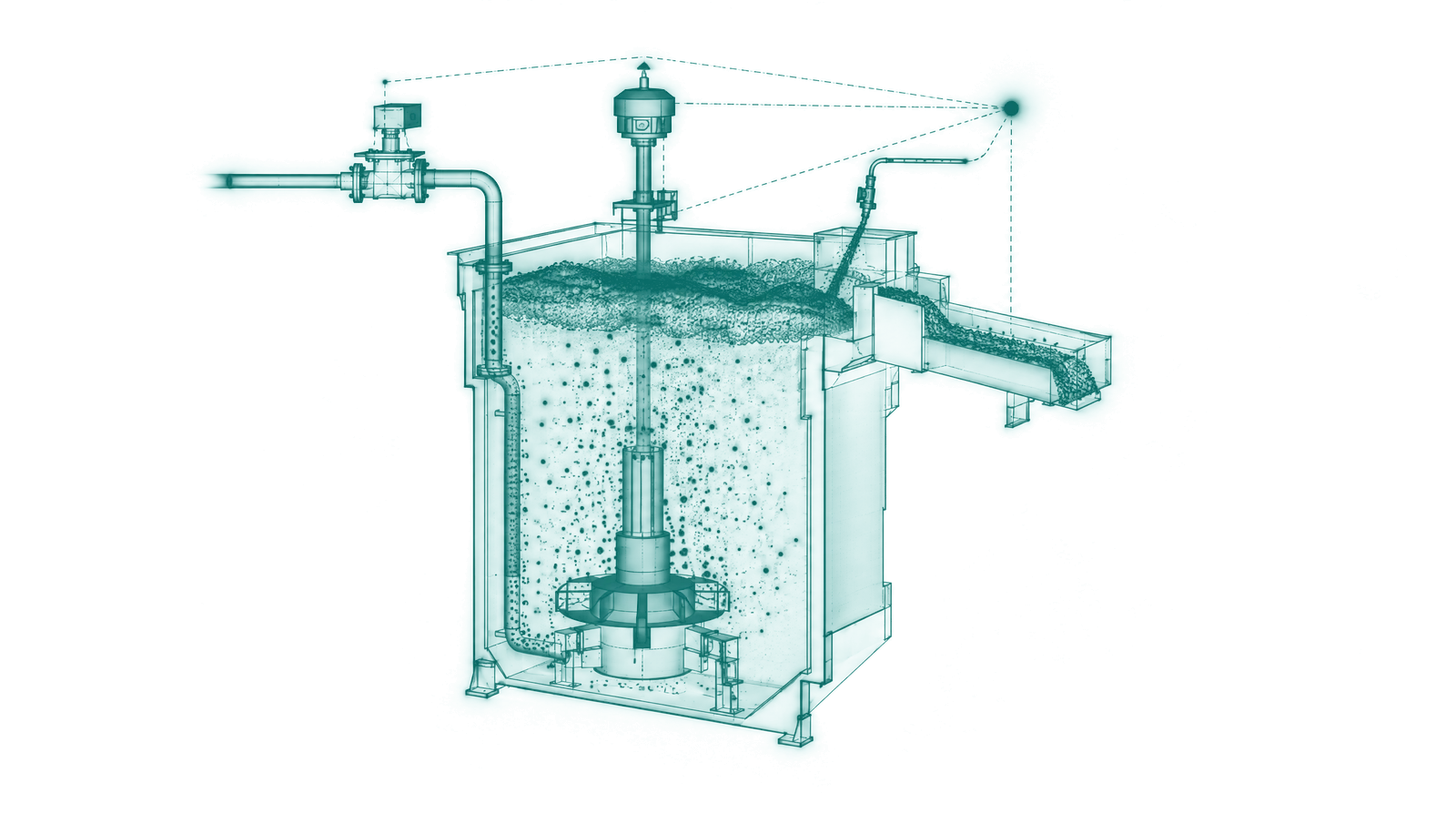
A closed-loop model uses pH, particle size, froth images and concentrate quality to predict how much collector or frother the slurry actually needs, then writes the new setpoints to the DCS. Because it learns from every process state, it adjusts dosage far more often than manual sampling allows, catches circuit upsets early, and uses downstream grade measurements to fine-tune upstream addition.
The result is lower reagent spend, cleaner tailings and a concentrate grade that stays on target as ore chemistry drifts.
5. Run in closed loop around the clock, inside set limits
Closed-loop control takes optimization past advisory mode. The controller writes setpoints to the DCS or the advanced process control (APC) layer and adjusts as the plant responds. It catches hidden inefficiencies, keeps every shift on consistent targets and makes the continuous corrections that manual control cannot sustain.
This brings the earlier methods together in one system: prediction, multivariable optimization, ore adaptation and reagent dosing. Sensors stream process data to on-site computing, and a transparent dashboard shows operators why the controller made each move, which answers the common concern about black-box AI. ARC Advisory Group calls this arrangement human on the loop: the AI calculates and executes, and the operator moves from manual controller to high-level supervisor.
Closed-loop control can reduce variability that depends on who is on shift, surface process interactions that operators miss, and hold recovery steady through staffing gaps. It also requires robust cybersecurity, clean data pathways and clear governance over model overrides.
When evaluating solutions, check for proven direct-to-control capability, transparent model logic and real post-deployment support. Operators who are involved from the start are more likely to trust the controller and keep it running.
Frequently asked questions
How much plant data does a mineral processing operation need to begin?
Most plants already have enough history in their control system and historian to start, and data quality improves as the work progresses. Models can begin learning from the sensor streams already collected at flotation cells, leaching circuits and grinding mills. Sensor calibration and reliable assays matter more than complete coverage. Rolling out circuit by circuit lets the team close data gaps where they appear, instead of overhauling all data before starting.
How does AI handle variable ore grades without constant recalibration?
A model trained on plant data learns how process variables respond across the range of ore grades the circuit actually sees, rather than at one fixed operating point. As grade shifts, it recognizes conditions it has seen before and adjusts pH, air flow and reagent dosing accordingly. Continued learning keeps it current as ore composition drifts across the deposit. Conventional controllers need retuning whenever the feed moves far enough from their commissioning baseline.
How do models coordinate flotation, leaching and purification?
The model treats connected circuits as one system. A change in flotation feed affects leaching residence time and purification load, and the model learns those relationships from operating history. When it searches for setpoints, it evaluates the economics of the full circuit together. That often reveals interactions that manual operation and fixed APC miss, particularly around reagent handoffs and intermediate grade targets.
How Imubit applies this
Imubit applies Map, Model and Control to mining and minerals operations. Map traces lost recovery, reagent and energy to the recurring decisions behind them. Model uses Deep Learning Process Control® (DLPC®) to learn a nonlinear dynamic model of each circuit from its own history, guided by first principles. Control writes setpoints to the existing APC or DCS minute by minute, inside limits set by plant engineers. In mining, minerals and metals, deployments have delivered a 1 to 3% metal-recovery improvement, 5 to 10% grinding-energy savings and a 2 to 5% throughput increase.