Industrial control systems run the front line of every process plant, and they have become a target. Manufacturing accounted for 25.7% of reported attacks, according to Cyber News Centre.
Traditional IT security puts data confidentiality first. A plant has to put safety and continuous availability first. Legacy controllers running outdated protocols, minimal logging and fragile firmware make that balance hard to hold, and they leave even well-maintained plants exposed to ransomware, hacktivists and supply-chain exploits.
This article covers five of those risks and practical steps to reduce each one without disrupting production.
1. Legacy system vulnerabilities
Controllers and workstations installed a decade or more ago are still common. They keep production running, upgrades are capital-intensive, and some vendors no longer issue patches. The same factors leave the plant exposed.
Outdated operating systems, unpatched firmware and obsolete software libraries give attackers easy entry. Many legacy devices communicate over protocols such as Modbus or BACnet, which lack authentication and encryption, a weakness highlighted in threat research from Aon.
A full hardware refresh rarely fits the production schedule, but the attack surface can shrink now:
- Build a living inventory of every legacy device, its software version and its known CVEs (Common Vulnerabilities and Exposures).
- Where production schedules rule out firmware updates, apply virtual patching or host-based firewalls as compensating controls.
- Schedule phased replacements during planned shutdowns, highest-risk assets first.
- Isolate equipment that cannot be replaced behind secure gateways or unidirectional diodes.
2. Insufficient network segmentation
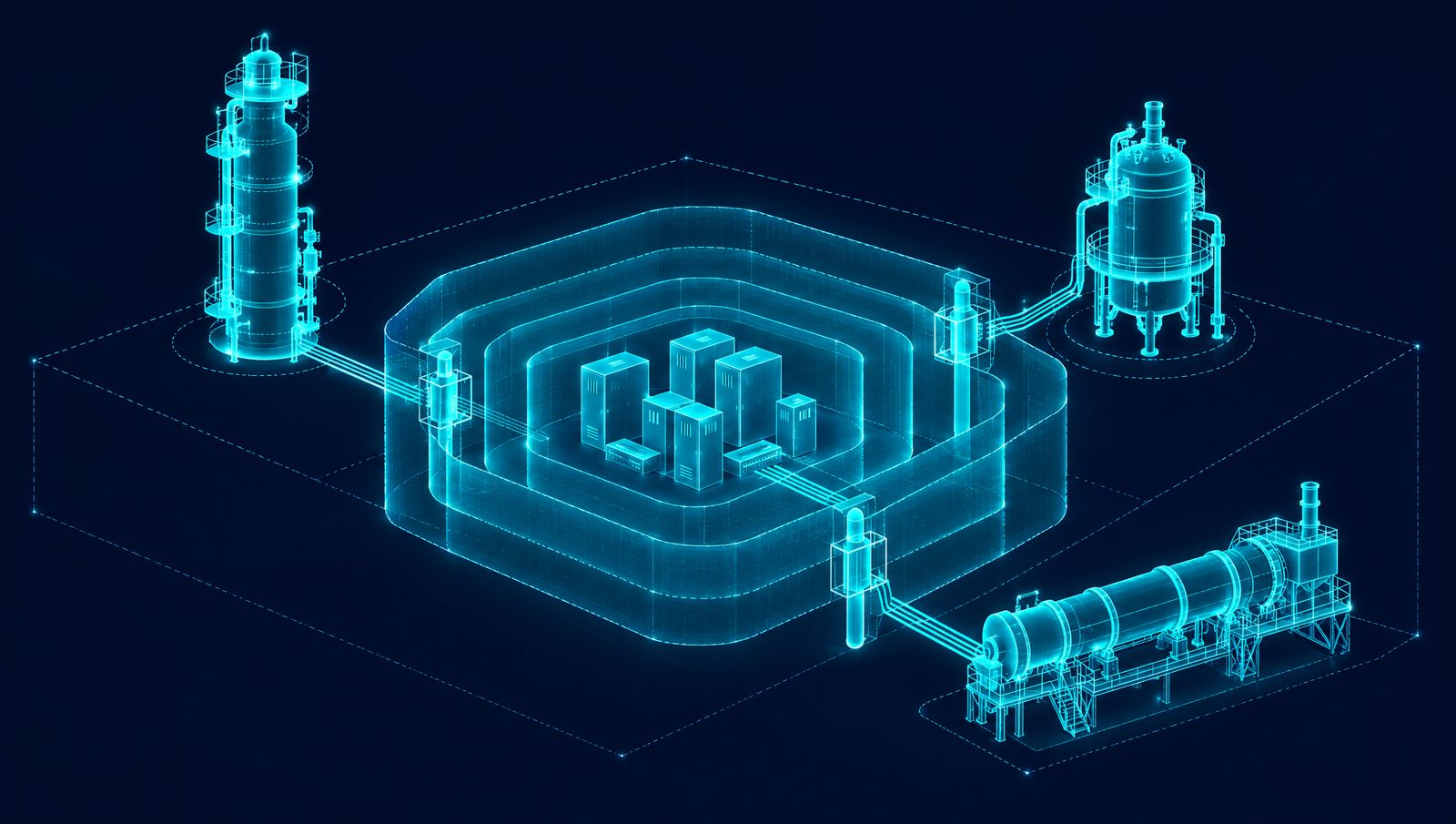
When every controller, workstation and historian sits on the same subnet, a single foothold lets an attacker move freely. Segmentation divides the control environment into zones, each with its own security boundary. The widely adopted Purdue Model separates enterprise IT from the safety-critical process layers.
Without enforced boundaries, a plant is exposed to lateral movement, multicast storms and uncontrolled traffic that can halt production. The 2021 Colonial Pipeline attack compromised the company's IT network, and the company shut down pipeline operations as a precaution. An incident on the IT side was enough to stop a major fuel artery.
Effective isolation is layered:
- Firewall-protected zones with tightly controlled conduits between them, and zero-trust rules for every cross-zone connection.
- Unidirectional gateways for the most critical systems, so there is no reverse path for an attacker to use.
- A dedicated demilitarized zone (DMZ) that brokers all traffic between the IT and OT networks.
- Regular penetration testing and packet captures to confirm the segmentation works under real conditions.
3. Poor access control and credential management
Weak or misplaced credentials remain the shortest path from the corporate network to safety-critical controllers. Because availability comes first in operational technology, many plants still share operator logins, leave vendor accounts active after maintenance, or run legacy PLCs on default passwords. Once an attacker captures one set of credentials, often through phishing or credential stuffing, they can move between assets that were never designed for multi-factor checks or granular roles.
A credential program treats every login as a potential fault line:
- Use privileged-access-management tools to enforce least privilege.
- Vault shared passwords and rotate them automatically.
- Require multi-factor authentication for every remote or administrative session.
- Give vendors just-in-time maintenance access, with the permissions the job needs, revoked when the job is done.
- Audit login and session logs continuously, and remove dormant and vendor accounts as soon as the work is finished.
The full credential lifecycle of provisioning, updating and revoking has to be managed without exception. A single overlooked maintenance account can be the entry point that stops the operation.
4. Lack of real-time monitoring and incident response
Without real-time visibility of the network, every industrial asset is a blind spot. Many plants still rely on the assumption of an air gap, so they deploy few sensors and collect limited logs. Threats can stay undetected long after the first compromise. CISA guidance for industrial environments stresses the ability to detect, respond and recover quickly, because availability, safety and regulatory compliance all depend on it.
A long mean time to detect and mean time to repair can turn an IT nuisance into a production crisis. In the Triton incident, malware targeting a safety-instrumented system went undetected for months, time the attackers used to refine their code.
Closing those gaps combines OT-aware technology with disciplined response planning:
- Intrusion detection tuned for industrial protocols rather than generic IT traffic.
- Behavior-based analytics that understand normal process conditions, which standard IT baselines can miss.
- Logs from every network segment aggregated in a secure, centrally managed repository.
- Rehearsed joint OT and IT playbooks, so incident commanders can act decisively under pressure.
- Machine-learning anomaly detection to flag subtle parameter drift or unauthorized code changes.
- Continuous monitoring across all segments, with coverage validated during routine security audits.
The aim is to turn what monitoring sees into a faster and more precise response.
5. Cyber-physical convergence risks
Cyber-physical attacks go beyond data breaches. They manipulate valves, breakers or safety systems and cause physical harm. Stuxnet, Triton and the Ukraine power-grid blackout showed that malicious code can sabotage centrifuges, tamper with safety-instrumented systems and cut electricity to entire regions.
A successful incident can take away process visibility, force costly shutdowns and endanger people. Cybersecurity planning therefore has to include safety integrity level (SIL) thresholds alongside confidentiality and uptime metrics.
Keeping a digital compromise from becoming a physical incident takes the cyber and process safety teams working together:
- Integrate process-safety alarms into security operations center (SOC) dashboards, so operators and analysts share one view of emerging threats.
- Harden safety-instrumented system logic and configuration management against unauthorized changes.
- Run joint IT and OT tabletop exercises that rehearse malware driving process conditions outside safe limits.
- Model physical consequences in risk assessments, so mitigation budgets reflect potential damage as well as data loss.
- Apply defense in depth, from authenticated field devices to network segmentation, to slow an attacker at every layer.
- Write response playbooks that define when to move from containment to an orderly, safety-focused shutdown.
Leaving the link between cyber and physical risk unaddressed exposes both plant reliability and the safety of the people on site. For how these risks sit across the control layers, see what each plant automation layer does.
How the Imubit Platform fits
Imubit applies Map, Model and Control in refining, chemicals and polymers, cement, and mining and minerals. Its Deep Learning Process Control® (DLPC®) models run on-premise and write setpoints to the existing APC or DCS, within limits the operators set. A model that has learned how a unit should respond also makes unexpected behavior easier to see. When measured values diverge from what the model predicts, engineers have an early signal to investigate, whether the cause is sensor drift, an unexpected setpoint move or something else. That complements the plant's OT security monitoring and does not stand in for it. See the platform.