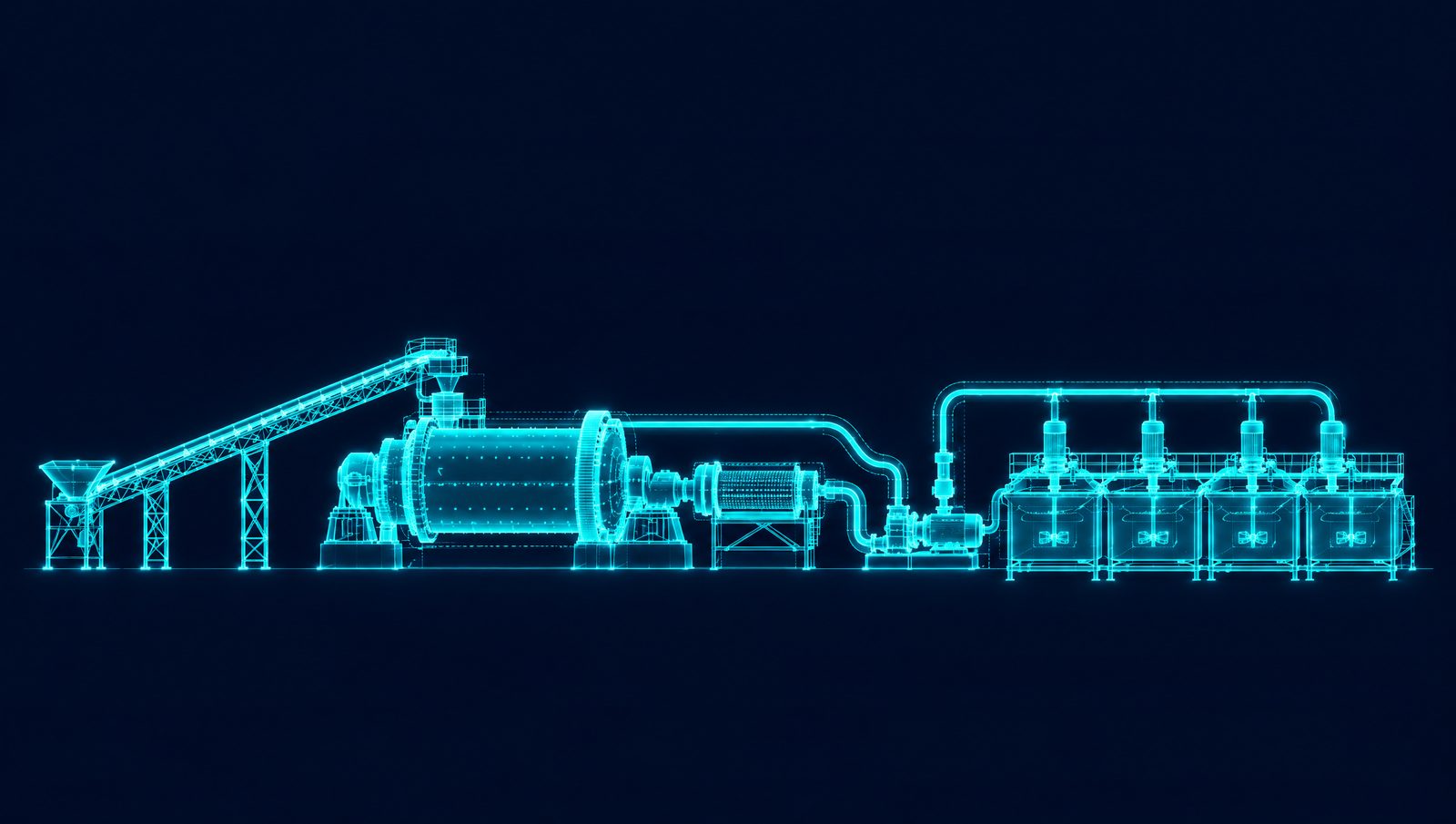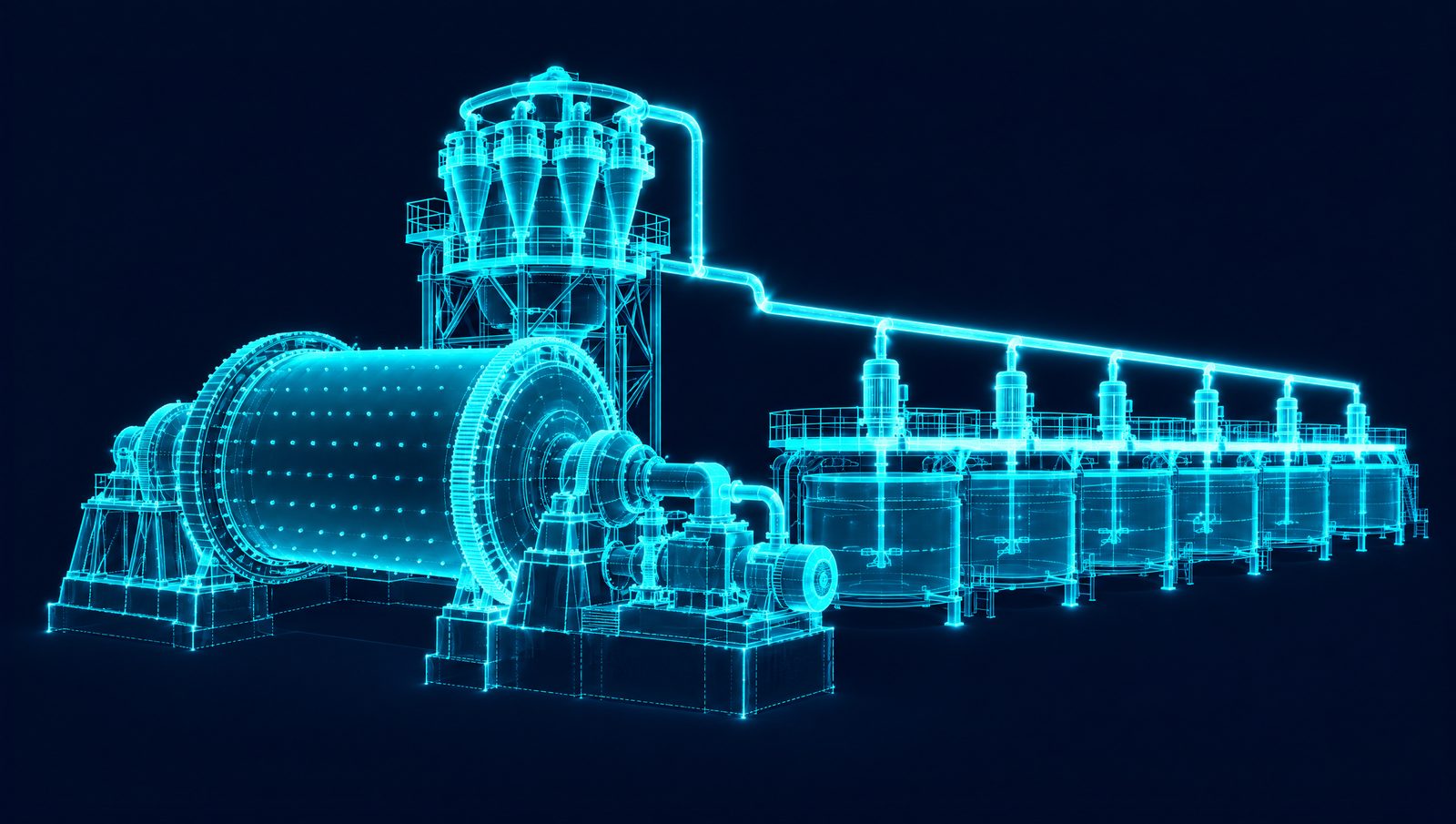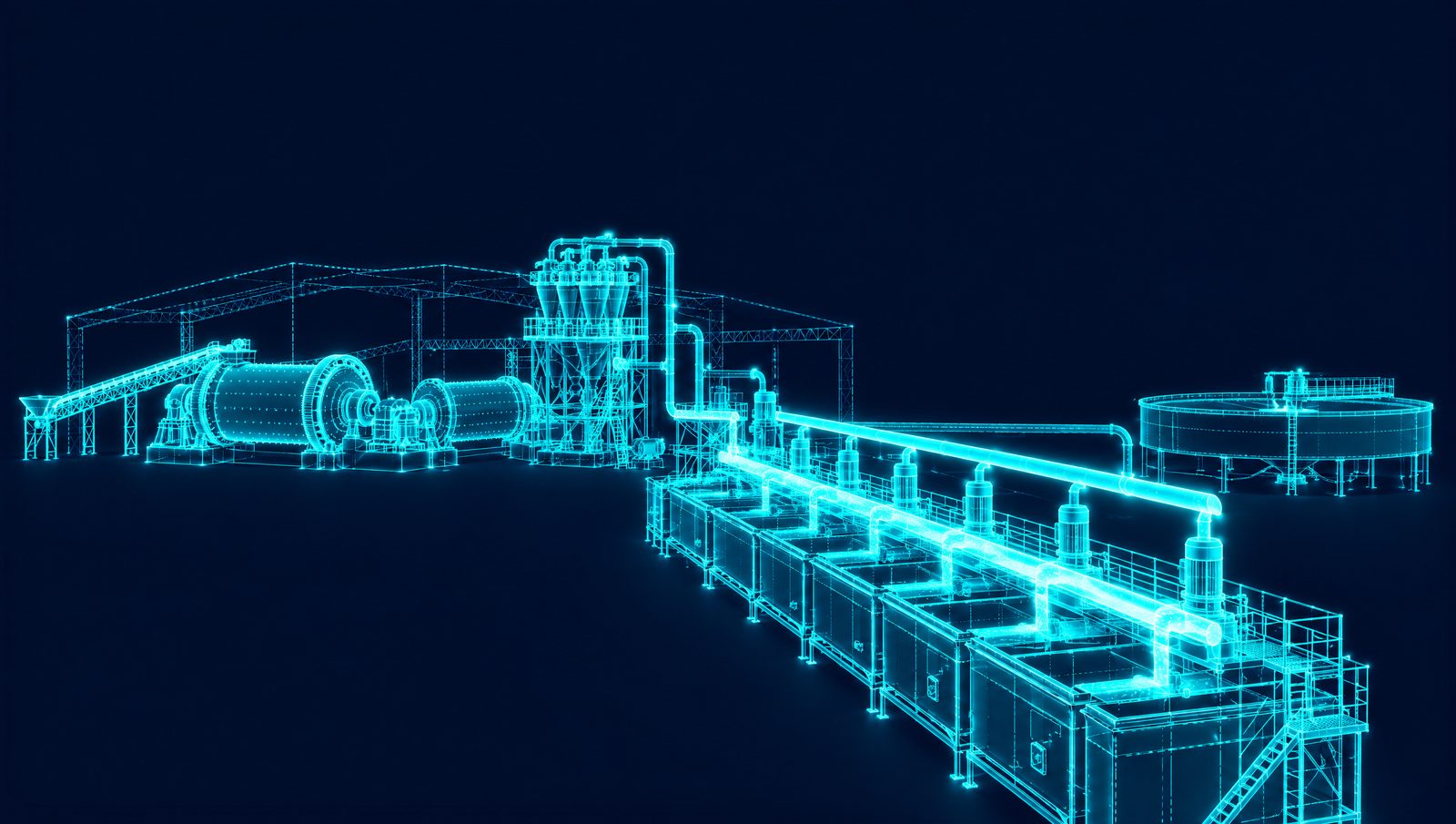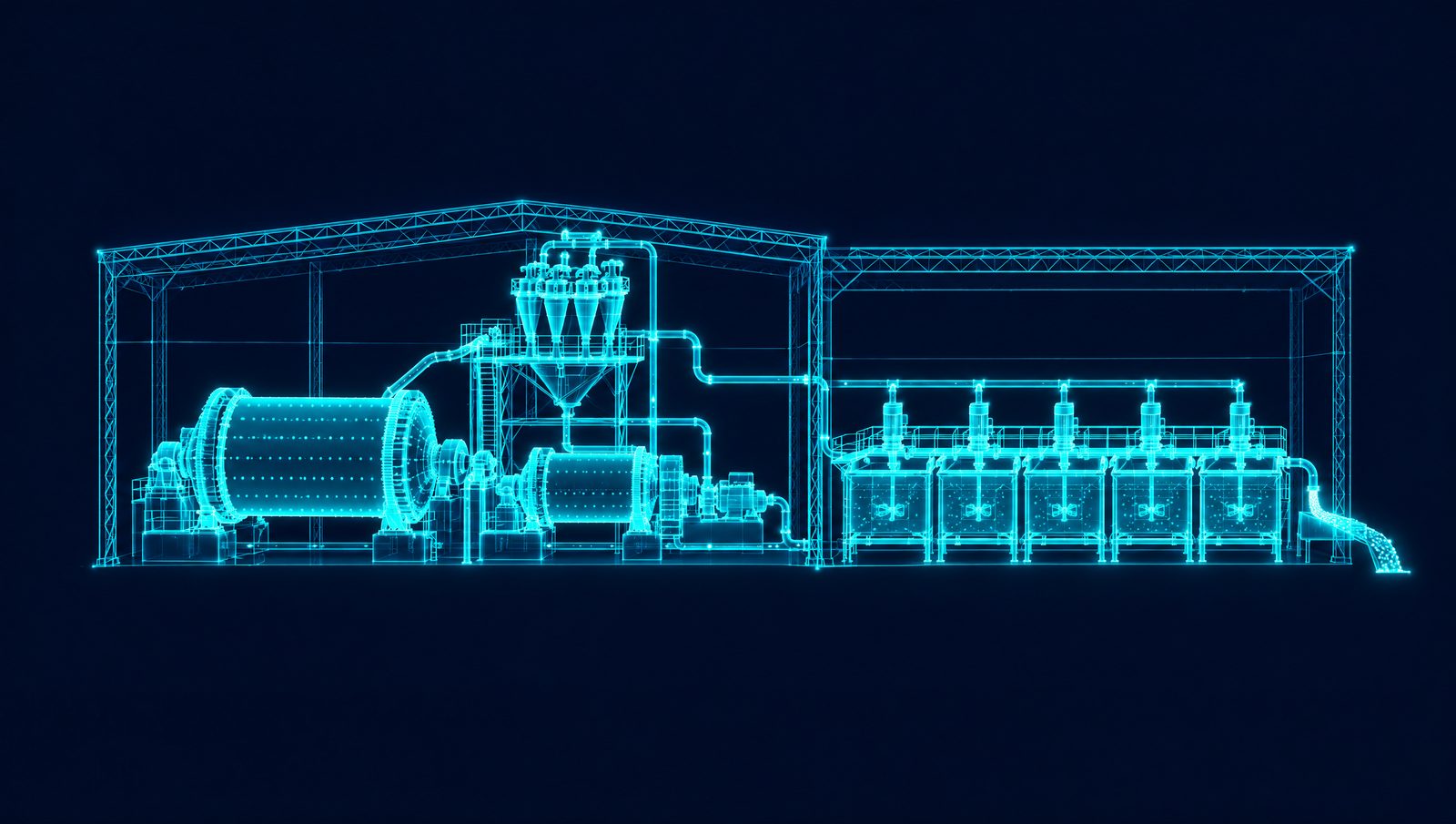
Every tonne of ore that leaves the mine has to be crushed, ground, separated and concentrated before any saleable metal reaches the market. That sequence of steps, mineral processing, decides whether a mine makes money on each shift.
Feed quality is moving in the wrong direction. The IEA's Global Critical Minerals Outlook 2025 points to a potential 30% supply shortfall in copper by 2035 from the current project pipeline, as ore grades decline, capital costs rise and lead times stay long. As feed quality drops, the energy used per tonne processed tends to climb.
Plants that run each stage well, and manage the handoffs between stages, protect their margins as grades decline and environmental requirements tighten. Below are the four stages, where conventional control reaches its limits, and what changes when the circuit is controlled as one system with learned process models.
What mineral processing does
Mineral processing sits between extraction at the mine and downstream metallurgy. It applies physical and chemical separation to raise the concentration of the target minerals while rejecting waste rock, known as gangue. The discipline spans dozens of unit operations, and they all serve one objective: a concentrate that meets smelter or refinery specifications at the lowest cost per tonne.
The metric that governs plant economics is recovery, the fraction of the valuable mineral carried from the ore into the final concentrate. Profitability depends on maximizing recovery while minimizing the energy and reagents consumed per tonne.
Because recovery applies to every tonne processed, small recovery gains carry large value. For operations managing declining ore grades, the efficiency of the processing plant can decide whether a deposit stays economic. That makes process optimization one of the higher-return levers available without new capital.
The four stages of mineral processing
Mineral processing moves through comminution, sizing and classification, concentration, and dewatering. Each stage builds on the one before it, and an inefficiency at any point cascades downstream.
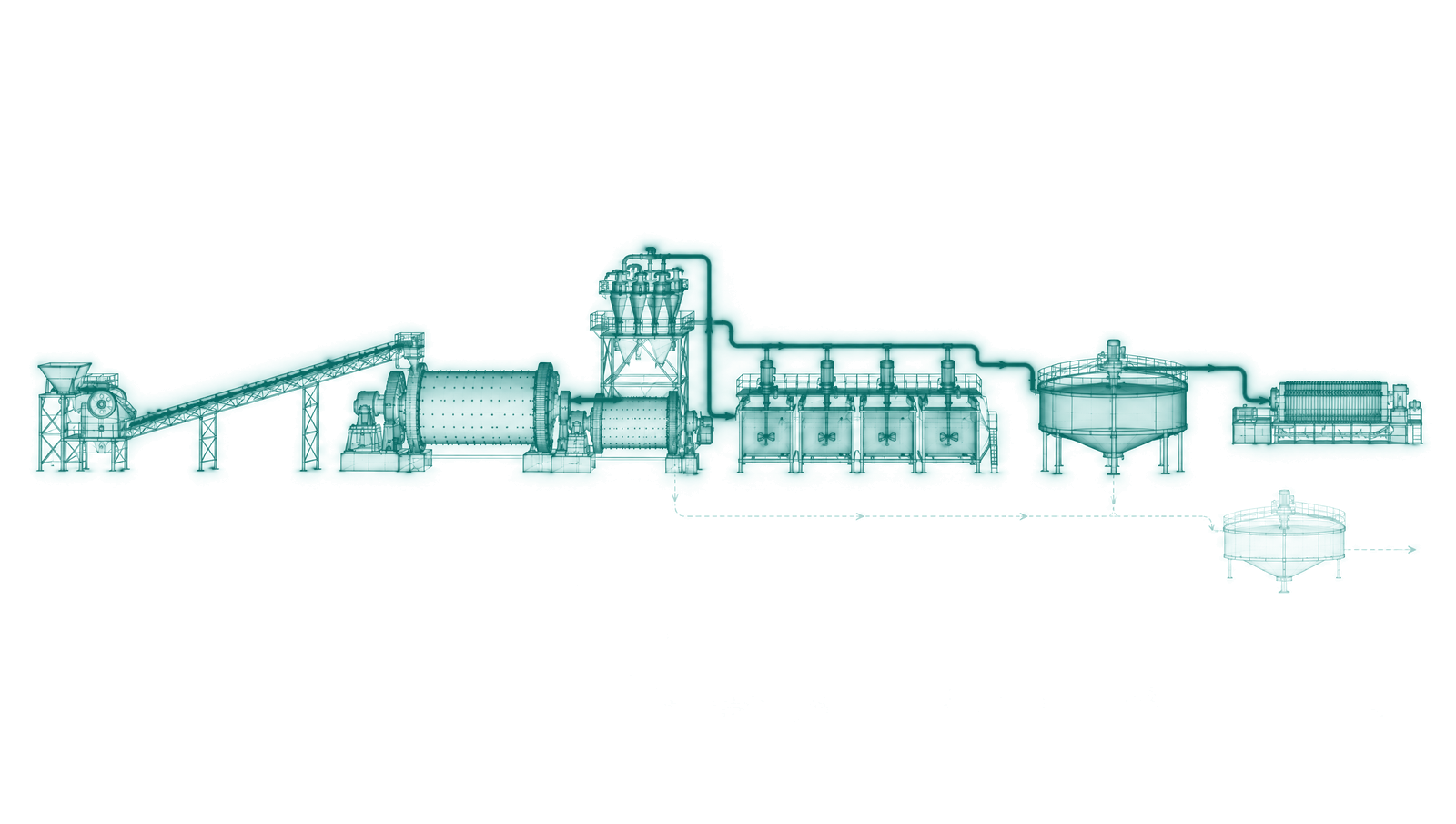
1. Comminution: crushing and grinding
Comminution breaks raw ore into particles fine enough to liberate the valuable minerals from the host rock. It runs from primary crushing in jaw or gyratory crushers, through secondary crushing in cone crushers, to grinding in SAG mills and ball mills.
This stage takes the largest share of a processing plant's energy, often half or more of total power use. The burden grows as ore grades decline and hardness increases, which are the conditions most operations face today. The key operating variables, mill speed, feed rate, water addition and media charge, interact nonlinearly, so optimizing one without accounting for the others rarely produces a lasting improvement.
The trade-off is constant. Over-grind and the plant wastes energy. Under-grind and valuable minerals stay locked in the rock, where flotation cannot recover them.
2. Sizing and classification
Hydrocyclones and vibrating screens send correctly sized material forward and return oversize particles to the grinding circuit. This stage acts as the control valve between comminution and concentration.
When classification drifts, fine material recirculates when it does not need to, wasting grinding energy, while coarse particles pass through to flotation, where they cannot be recovered. Hydrocyclone performance shifts with feed density, flow rate and wear, often faster than operators can detect through periodic sampling. An accurate particle size distribution matters for everything that follows.
3. Concentration
Concentration separates valuable minerals from gangue using differences in physical and surface chemical properties. Common methods are froth flotation for copper, lead and zinc, gravity separation for gold and tin, and magnetic separation for iron and titanium ores.
Flotation, the most common route for base metals, is sensitive to reagent dosing, froth depth, air flow and feed chemistry. All of these shift as ore composition changes, so the best operating conditions on one shift rarely carry over to the next.
Recovery losses at this stage are especially costly, because the upstream energy and reagents have already been spent. Every point of valuable mineral that reports to tailings instead of concentrate is a sunk cost.
4. Dewatering
Once the concentrate is produced, the water has to come out. Thickeners, filter presses and thermal dryers reduce moisture in steps so the concentrate can be handled and shipped. Moisture specifications are tight. Too wet, and the concentrate draws penalties or rejection at the smelter. Too dry, and the plant spends energy it did not need to.
Dewatering affects both concentrate quality and tailings disposal cost. Thickener underflow density, flocculant dosing and filter cycle times all influence final moisture, and the right balance shifts with feed variability. Small losses at this stage add up across thousands of tonnes per day.
Where conventional control reaches its limits
Each stage introduces variability that compounds through the circuit. Ore hardness changes between shifts, feed grades drift faster than lab results arrive, and reagent effectiveness moves with water chemistry.
Single loops see one variable
PID loops and conventional advanced process control (APC) hold their targets well within the range of conditions they were designed and identified for, which is narrower than most plants now face. A PID controller holding cyclone pressure does not know that ore hardness shifted upstream. A flotation controller working on froth depth has no view of how grinding conditions changed minutes earlier.
Even well-tuned APC applications degrade as ore characteristics shift over months. At many sites, a significant share of installed APC falls out of active use, because retuning takes specialized engineering time that operations can rarely spare.
The gap widens as ore gets harder to process
Operations fall into a reactive pattern, with operators chasing upsets instead of preventing them. Recovery slips in the lag between a disturbance and the corrective response. Optimizing a single unit can push the bottleneck downstream instead of resolving it, and local improvements disappear at the system level.
These limits matter more as ore becomes more variable. When a plant processed consistent, high-grade feed, rule-based control worked well enough. With lower grades and more complex mineralogy, the gap between what conventional control achieves and what the plant could achieve widens with every shift. Many plants leave recovery on the table because their control systems cannot respond fast enough to changing conditions.
How learned models coordinate the circuit
A learned process model approaches the problem differently. Instead of optimizing comminution, classification, flotation and dewatering in isolation, it learns the nonlinear relationships among hundreds of variables across the whole circuit, from crusher gap settings and mill power draw through to flotation concentrate grade and thickener underflow density.
Adjusting setpoints as the feed changes
The model reads sensor data, lab results and operating conditions and calculates setpoints continuously. When ore hardness shifts, it adjusts mill speed and pulp density before the change reaches flotation. When reagent response drifts, it adjusts dosing against predicted recovery instead of waiting for off-spec concentrate to show up in the sample results.
Setpoints can then track the feed instead of sitting at one conservative setting for the whole day. Plants with highly variable ore bodies tend to benefit most, because the model responds faster than manual adjustment and holds recovery rates steadier through feed transitions.
Treating the plant as one system
The larger returns come from coordinating the plant as a whole. Treating crushers, mills, cyclones and flotation cells as one dynamic network keeps a local optimization from starving the units downstream. When cyclone pressure drifts or a pump trips, the model adjusts throughput targets across the circuit to hold total production where it can, rather than forcing an unplanned stop.
Lower grinding energy per tonne also cuts operating cost and the emissions tied to the site's power use, which supports sustainability goals in mining alongside the margin case.
Keeping operator knowledge in the plant
The same models serve as training tools. New operators can work through operating scenarios in a simulation built from the plant's own data, alongside traditional mentoring. For operations facing workforce transitions, this keeps institutional knowledge in the model when experienced staff retire.
From recommendations to closed loop
The model works with the existing distributed control system (DCS) and APC. It reads process data and writes setpoints through the plant's control architecture, and nothing in the existing control layer is removed.
Deployments usually start with recommendations, where operators review and approve each move before the model writes any setpoint to the control system. Trust builds on demonstrated accuracy. Teams then move to closed loop at their own pace, within limits the operations team sets, with operators keeping authority at every stage.
How Imubit applies this
In mining, minerals and metals, Imubit applies Map, Model and Control. Map traces recovery, energy and reagent losses to the recurring decisions behind them, such as grind targets and reagent dosing set against a delayed assay. Model uses Deep Learning Process Control® (DLPC®) to learn a nonlinear dynamic model of the grinding, classification and flotation circuits from their own history, guided by first principles. Control takes those decisions to closed loop on top of the existing APC and DCS, inside limits set by plant engineers. Imubit's published figures for mining, minerals and metals are a 1 to 3% metal-recovery improvement, 5 to 10% grinding-energy savings and a 2 to 5% throughput increase.