Chemical plants are being asked to meet aggressive carbon targets without giving up margin. The industry is a large emitter, and there is no single route to decarbonization. The traditional options, such as major equipment upgrades or running at lower rates, cost either capital or production.
Better operation is a complementary route. Much of a plant's energy use and emissions is set by how its units run: reactor conditions, column energy, furnace firing and the site steam balance. Optimizing those decisions can lower energy per tonne of product while holding or raising throughput, with the equipment already installed.
AI applies to this problem at three scales: materials and catalyst discovery at the molecular level, process control at the unit and plant level, and coordination of utilities across an industrial park. This guide covers the readiness checks to run first, what each scale offers, the common pitfalls, and how to measure and scale results.
Readiness checks
Checking readiness in four areas before a project starts exposes gaps early, when they are cheap to close.
Data
Data quality is one of the main constraints on AI projects in chemical plants, as Chemical Processing has reported. Legacy systems often lack the instrumentation for complete monitoring. Missing tags, drifting sensors and gaps in the history need attention before any model is trained.
Infrastructure
The plant needs secure connections between operational technology and IT systems. Integration with the existing DCS and automation platforms runs through standard protocols such as OPC UA. Interfaces to advanced process control let a closed-loop optimizer write targets through the existing control layer, while the safety systems stay independent of it.
People and organization
Success needs visible leadership commitment and cross-functional engagement: a sponsor at COO level, plant managers who lead the work day to day, and operator champions who are willing to try new tools. Change management matters as teams move from established methods to model-based optimization.
Common barriers
- Staff bandwidth. Limited engineering time often delays projects. Working with an experienced provider eases the load.
- Cybersecurity. Most plants have cybersecurity concerns that call for clear data governance from the start.
- Operator resistance. Resistance eases when models are transparent and explainable, and when operators help validate them and keep their role in running the unit.
Three scales of AI for decarbonization
Each scale works on a different time horizon, from reductions available on today's units to the materials that longer-term targets depend on.
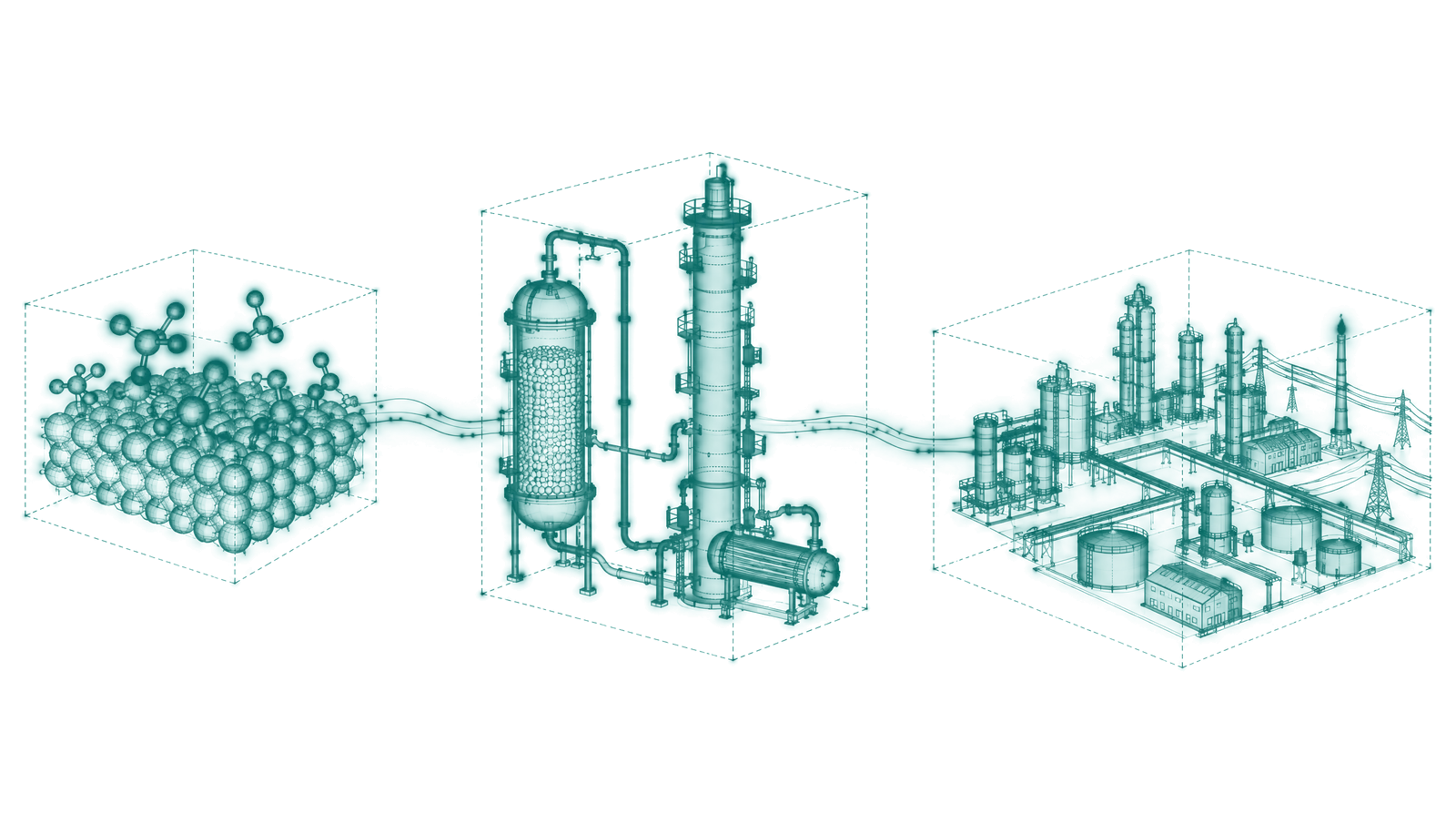
Microscale: materials and catalysts
At the molecular level, AI models predict how materials will perform, which helps R&D teams find better catalysts and separation materials faster than trial and error. Conventional catalyst development consumes large resources for uncertain results. Models can screen large chemical spaces for compounds that lower energy requirements or enable greener reaction pathways.
Solvent screening for carbon capture is a good example. Conventional methods might test dozens of candidates. Model-guided screening can evaluate thousands of molecular configurations and predict their performance before any lab work begins, which shortens the path to more efficient CO₂ capture.
Mesoscale: units, processes and plants
Most near-term reductions come from this scale. Here, optimization adjusts reactor temperatures, pressures and flow rates to reduce energy consumption and improve throughput at the same time.
The constraint for front-line operations is balancing production targets against energy cost while holding product quality. Models that learn from the plant's own operating data can keep that balance as conditions change. When a distillation column drifts toward inefficient operation, for example, the optimizer can adjust reboiler steam and column pressure to hold the separation with less energy input, within the limits set by condenser capacity, flooding and product specifications.
The same data supports reliability. Patterns in sensor data can flag equipment problems before they become energy-wasting failures or unplanned shutdowns, and shutdowns matter for carbon because restarts bring flaring and off-spec production.
Macroscale: industrial park symbiosis
At the largest scale, optimization coordinates multiple production units, utilities and even neighboring facilities, so that a plant becomes part of a wider system designed for resource efficiency.
The constraint here is coordination. Industrial symbiosis means balancing utilities and waste-heat sharing across processes with different schedules and requirements. When an ethylene unit produces excess steam, for example, a park-level model can identify the best destination for it: polymer finishing, a neighboring facility, or power generation.
Park-level optimization can also align production schedules with solar and wind availability, which reduces grid draw during periods when grid carbon intensity is high.
Common pitfalls and how to avoid them
Optimization projects in chemical plants tend to stumble on the same five obstacles.
- Poor data quality. Legacy systems lack sensors, which leaves gaps in the history. Start with a detailed data audit, fix sensor drift and missing tags, add monitoring where it is needed, and set up long-term data cleaning.
- Scope creep. Trying to solve every problem at once overwhelms resources and blurs the return. Focus on a single energy-intensive unit, prove the value there, then expand in stages.
- Operator resistance. Distrust of AI and concern about job security slow adoption. Use explainable models, involve operators in validation, and offer hands-on training.
- Integration delays. Poor compatibility with the DCS and historian slows deployment. Choose solutions built on standard protocols and involve IT and OT teams from the start.
- Unclear KPIs. Vague goals make success hard to prove. Define precise metrics, such as margin per tonne and CO₂ reduced per day, and track them in real time.
Practices that work
- Start where energy is concentrated. Pick a focused set of energy-intensive units, such as ammonia recovery or evaporator plants, rather than a full-plant program.
- Make the models explainable. Dashboards that show the link between a recommended move and the process outcome build operator trust.
- Retrain as the plant changes. Update models as feedstocks, equipment condition and operating variability change.
- Prove value, then scale. Expand across units and sites once the first application has shown results.
Measuring results and scaling across sites
Three KPIs connect directly to cost and to ESG goals: margin per tonne, kilograms of CO₂e reduced, and energy used per tonne of product. Real-time dashboards show where energy is lost across equipment, flag anomalies, and communicate ongoing value to stakeholders.
Scaling needs a clear governance model. Cross-site teams keep deployments consistent, and models and templates built at one plant can be reused at similar plants. The value case should count direct savings in fuel and steam and indirect benefits such as lower maintenance cost and better compliance. Documented learnings, standard practices and recurring performance reviews keep the results in place across sites.
Preparing for 2030 and 2050 targets
Unit-level optimization today is the foundation for longer-term targets. Research into AI-guided material discovery is already identifying catalysts for green hydrogen integration and circular feedstock processing. Those feeds are more variable than today's, which makes real-time optimization more important for holding production targets as the input streams change.
How the Imubit Platform applies
The Imubit Platform works at the process-unit scale, where energy and emissions are set by operating decisions every minute. Map traces excess energy use and emissions to the recurring decisions behind them. Model learns each unit's causality from its own operating history with Deep Learning Process Control® (DLPC®). Control takes the critical decisions to closed loop, inside limits set by plant engineers, writing setpoints through the existing APC and DCS. Where energy is the optimization target, deployments have delivered a 15 to 30% reduction in energy consumption. Read more about chemicals and polymers.