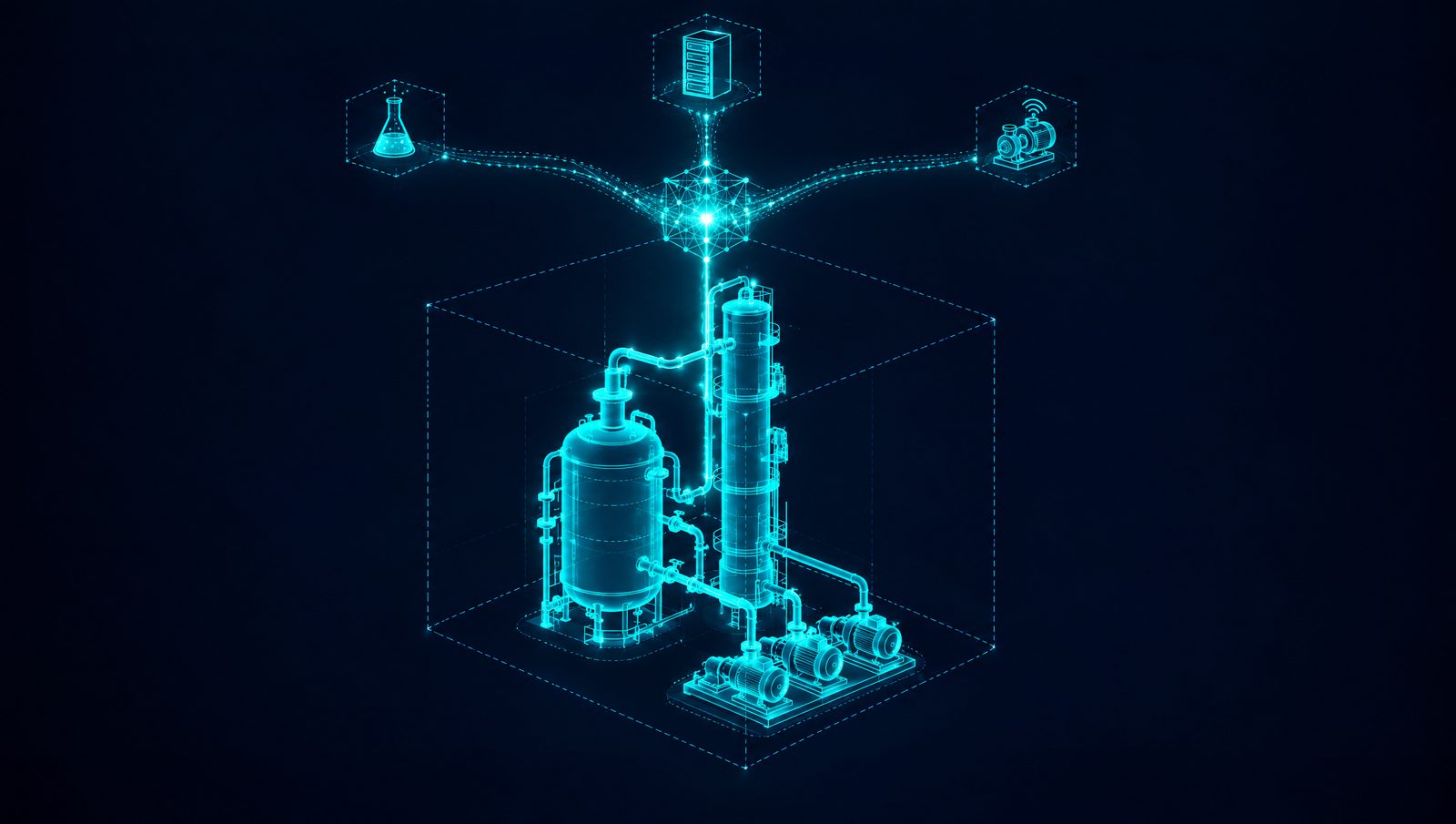
Manufacturers are building AI into their operations plans, but the distance between ambition and realized value is still wide. Pilots that stall and models that never reach production cost productivity and leave executives skeptical.
In process plants, five constraints usually decide whether an AI initiative scales or fades as a proof of concept: fragmented data, a widening skills gap, unclear ROI, legacy control and IT infrastructure, and uneven change management. Each has practical, well-understood remedies.
1. Fragmented, disconnected data
Plant data lives in many places. ERP databases, IoT devices and decades-old PLCs each use their own naming conventions and store information in proprietary formats. Missing sensor readings leave gaps that break model training, and security and regulatory requirements restrict access to the data a model needs. A survey summarized by IIoT World ranks data readiness as the top barrier to industrial AI.
A systematic approach to data governance and integration works best:
- Run a plant-wide data inventory that maps every sensor, historian and database.
- Use integration platforms or ETL pipelines that standardize tags before data reaches the model.
- Set up a data quality framework with automated validation and cleansing, so errors are caught before they reach a model.
- Start with a small "golden dataset" pilot, so the team can test data flows, find bottlenecks and refine the process before scaling, without touching production systems.
- Use masking or encryption to protect sensitive streams while keeping them available to the models that need them.
Clean, accessible data removes the rework that slows most AI projects. It does not mean waiting for perfect data before modeling starts. Models and data quality can improve together, as covered in five hidden barriers to AI adoption in the process industries. For more on turning plant data into decisions, see manufacturing data analytics with AI.
2. The workforce skills and culture gap
Industrial AI needs people who can run it. A 2025 Nash Squared survey found that the AI skills shortage now exceeds the gaps in big data and cybersecurity.
Without those skills, pilots stall and process knowledge leaves the plant as experienced operators retire. Younger engineers often pass over the industry unless they see modern, AI-supported careers in it. The result is slower implementation and smaller returns.
The most effective response combines workforce development with practical partnerships:
- Upskill current operators with simulators and focused training that build on their process knowledge.
- Form cross-functional teams that pair process engineers with data scientists, so knowledge moves in both directions while operations continue.
- Give operators explainable dashboards that show the reasoning behind each recommendation. Operators who can see why a move is recommended are more willing to work with it.
- Develop curricula with universities or vendors to build a pipeline of skilled people.
- Capture veteran knowledge before retirement, including with generative AI tools, so decades of process expertise stay accessible.
- Budget reskilling like a capital project, with its own funding, owners and milestones.
Organizations that treat workforce development as seriously as the technology tend to see higher adoption and stronger returns.
3. Proving the ROI
Budgets for industrial AI keep growing, and the basic question remains whether the investment will pay off. Many pilots show promise, but hidden integration costs, slow returns and vague success metrics make it hard to turn early results into audited financial impact. An executive survey reported by the Process Excellence Network describes companies moving from a fail-fast approach to more cautious adoption for exactly this reason.
The answer is to treat each AI application like any other capital project, with the numbers worked out in advance:
- Tie each use case to a P&L lever. Higher yield, lower energy consumption, less scrap and less unplanned downtime are levers finance already recognizes.
- Capture a solid baseline before deployment. Historical data provides the counterfactual that results are measured against once the model goes live.
- Map benefits and risks in a value-driver tree. Trace how throughput gains on one unit carry through to margin across the site.
- Calculate total cost of ownership. Include model retraining, data infrastructure and support for front-line operations. Surprises erode trust faster than poor accuracy does.
- Run a proof of value on archived data. Set realistic performance thresholds, and compare the projected savings against existing APC efforts.
- Track results against the baseline continuously. Dashboards that show yield, energy and downtime against the pre-AI baseline let executives confirm that returns exceed the investment.
When ROI is quantified end to end, including costs, benefits and risks, executive sponsors have the confidence to move from pilot to plant-wide scale.
4. Working with legacy machinery and control systems
Many plants still run proprietary PLC protocols and air-gapped networks, and poor connectivity is a common obstacle to AI. It is tempting to delay modernization, but production data that sits unused delivers nothing while it waits.
The path forward does not require wholesale replacement:
- Connect through edge gateways. Vendor-agnostic gateways translate Modbus, OPC or custom tags into open standards without touching control logic, which preserves the existing investment.
- Add closed-loop optimization once connectivity is in place. A model learned from plant history can find nonlinear relationships that conventional APC misses.
- Start in advisory mode. Let the controller observe operations and recommend moves, and benchmark its recommendations before allowing it to write setpoints. This builds confidence while keeping risk low.
- Align cutovers with maintenance windows. Treat integration as part of normal equipment lifecycle management, to limit disruption to operations.
- Bring cybersecurity in early. Enforce zero-trust segmentation around new data pipelines.
- Test in simulation. Stress-test models offline before they move a valve or a control loop.
Handled one step at a time, integration becomes a low-risk evolution of the existing system. Each successful connection builds experience for the next.
5. Change management and scaling beyond the pilot
Promising AI pilots stall when leadership, metrics and mindsets pull in different directions. Competing KPIs crowd out long-term goals, front-line skepticism grows, and governance fades once the initial attention passes. Projects scale when the people involved move together with the technology.
To take industrial AI past the pilot:
- Secure an executive sponsor and form a cross-disciplinary steering committee that meets weekly, keeps momentum and resolves KPI conflicts early.
- Publish plant-level success metrics such as uptime, energy intensity and yield, so every stakeholder reads the same scoreboard.
- Roll out in stages, from a single line to a cell to a network. Each release captures feedback and lets the team adjust the model before it reaches higher-risk systems.
- Show operators the reasoning. Dashboards that explain why each move is recommended build trust.
- Keep feedback loops open after go-live with regular sessions where operators review the system. Sustained reinforcement prevents regression and surfaces insights that improve the model.
- Resource change management like a capital project, with dedicated people, clear milestones and regular reviews.
When communication, training and governance scale with the technology, pilots become standard operation.
Where to start
Data readiness, workforce capability, ROI discipline, integration with legacy systems and change management are the five levers that separate stalled pilots from plant-wide value. Each one needs to be run as a program with an owner.
Make a candid assessment of where the plant stands on each lever, then prioritize the constraints that most limit front-line operations. A readiness evaluation or a tightly scoped golden dataset pilot will surface the gaps before significant capital is committed. Give equal attention to the algorithms and to the people who have to trust them.
How the Imubit Platform applies
For plants in refining, chemicals and polymers, cement, and mining and minerals, the Imubit Platform applies Map, Model, Control. Map traces plan-to-plant gaps to the recurring decisions behind them, Model learns the causality of each unit from its own history with Deep Learning Process Control® (DLPC®), and Control takes the critical decisions to closed loop on top of the existing APC and DCS. See how the platform works.