Ore grades at mature mines are falling, and the operational complexity of extracting value from lower-quality deposits keeps rising. At the same time, demand for critical minerals is growing, energy costs are climbing, and environmental, social and governance expectations tighten every year.
AI is being applied across the mining value chain, from exploration targeting and autonomous haulage to mineral processing and workforce development. Its effect runs deepest inside the processing plant, where shifting ore characteristics, tight quality targets and thousands of interacting variables have long resisted conventional control.
AI across the mining value chain
In exploration, models analyze geological, geophysical and geochemical data to find high-probability mineral targets faster, and with less ground disturbance, than traditional drilling campaigns. Autonomous haul trucks, drills and loaders now run at scale at major open-pit operations, which keeps crews out of high-risk zones and improves equipment utilization.
Condition-based monitoring uses vibration, temperature and power-draw sensors to flag equipment anomalies before failures occur. A failure that would have been a breakdown becomes a planned maintenance interval instead.
These upstream capabilities matter for the whole value chain. The processing plant, though, is where the most complex variables interact and where the most margin sits uncaptured. Exploration and haulage improve how ore reaches the plant. Processing optimization improves what happens to every tonne once it arrives.
Why the processing plant is hard to optimize
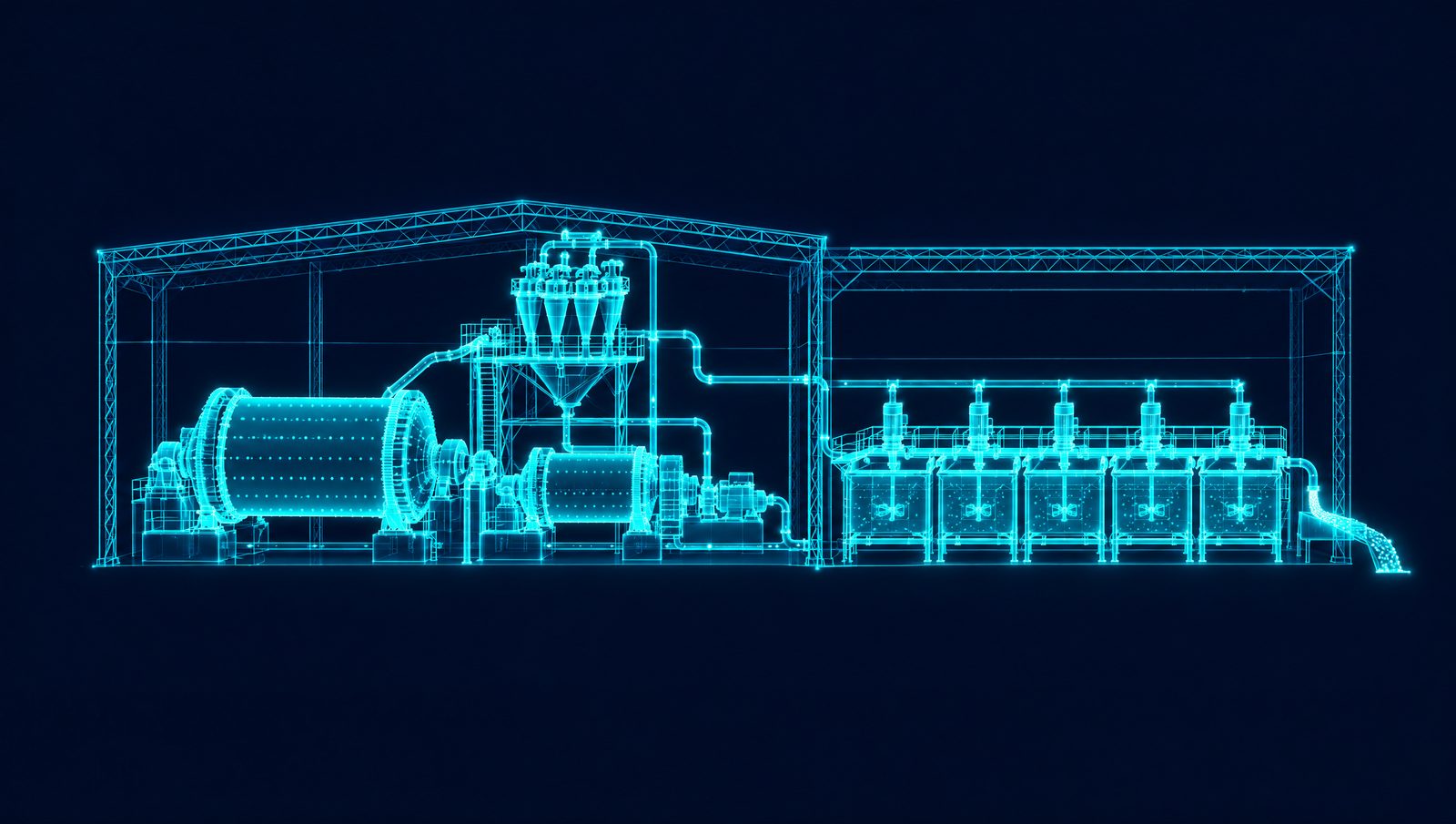
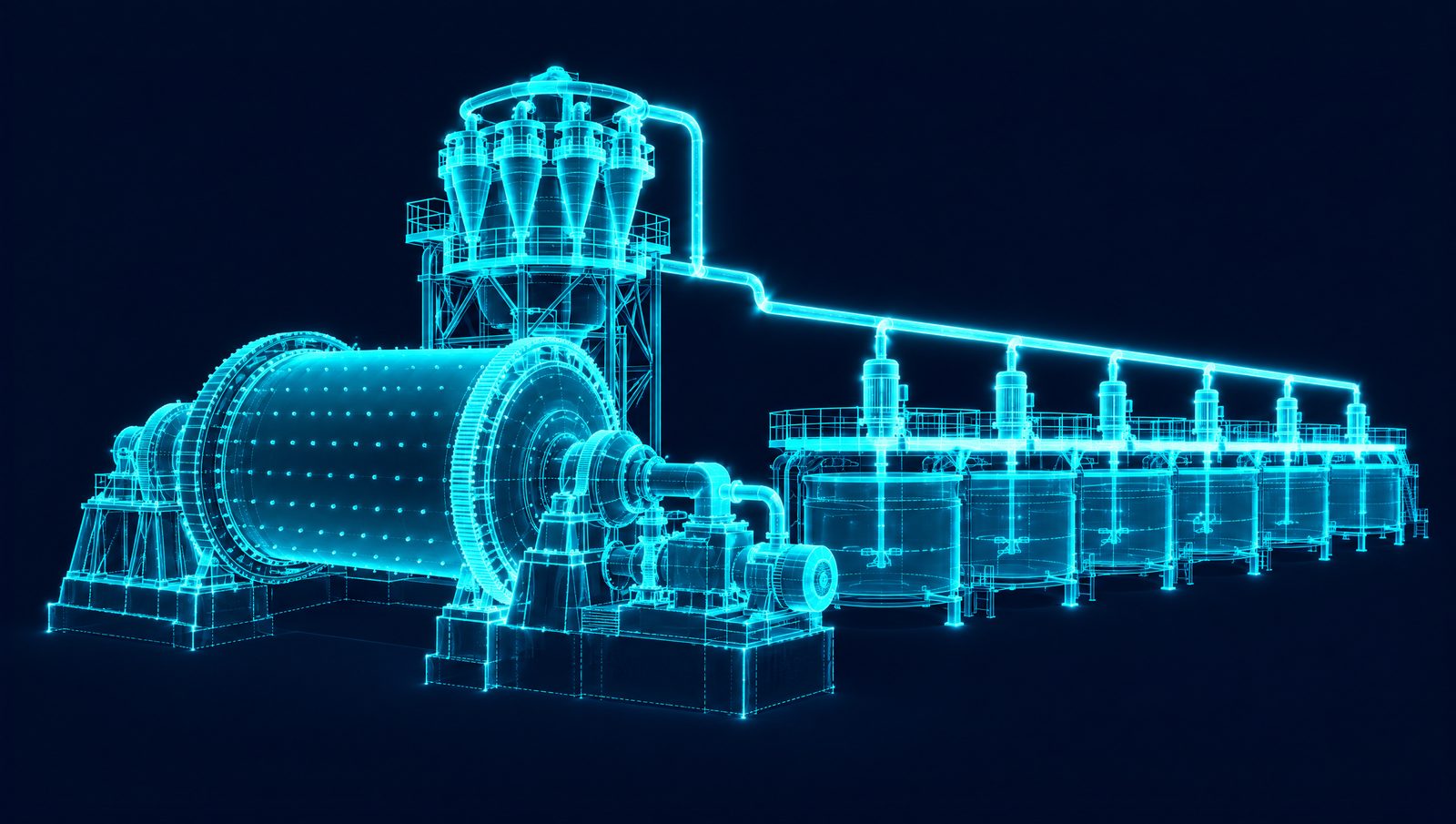
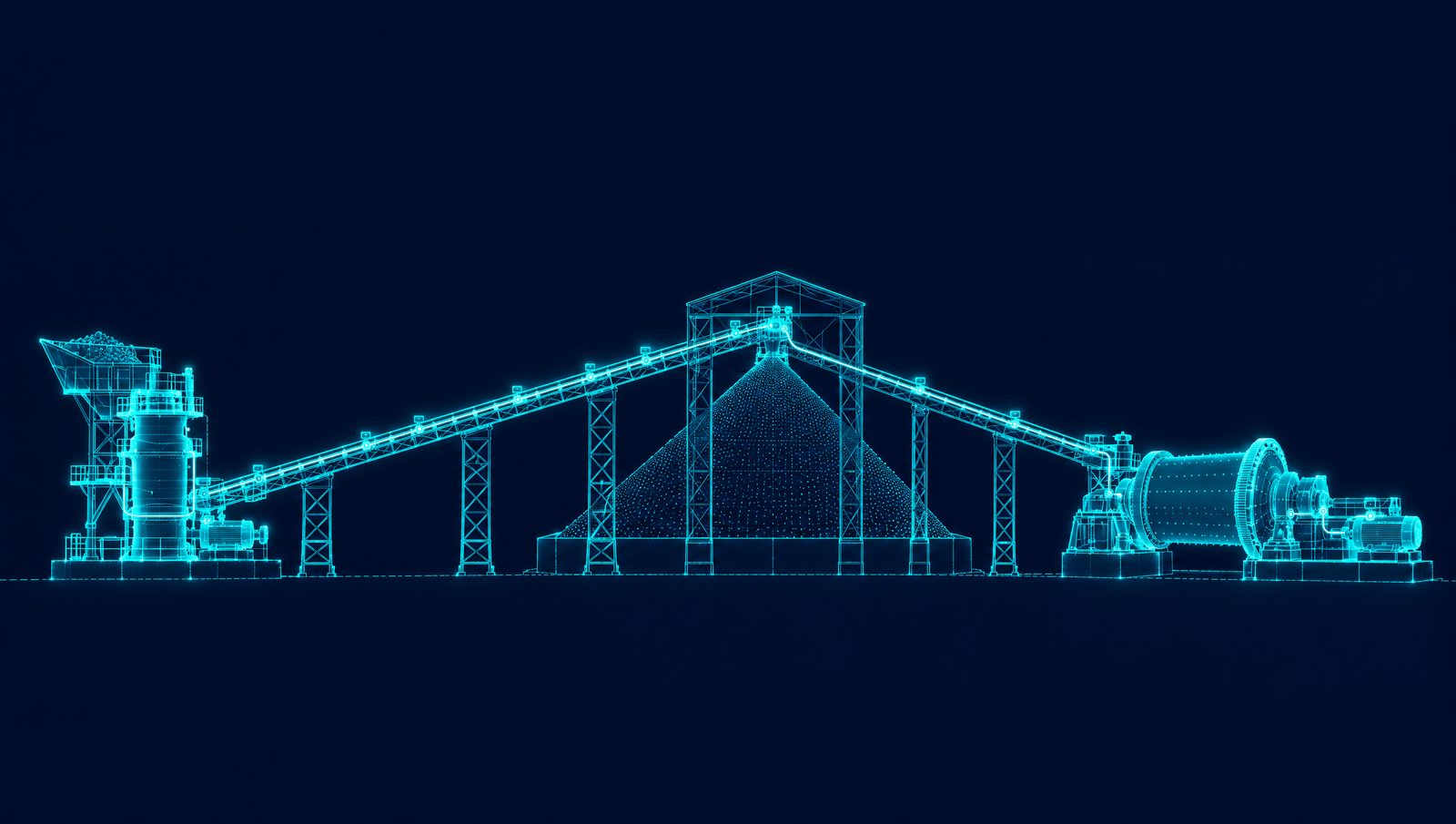
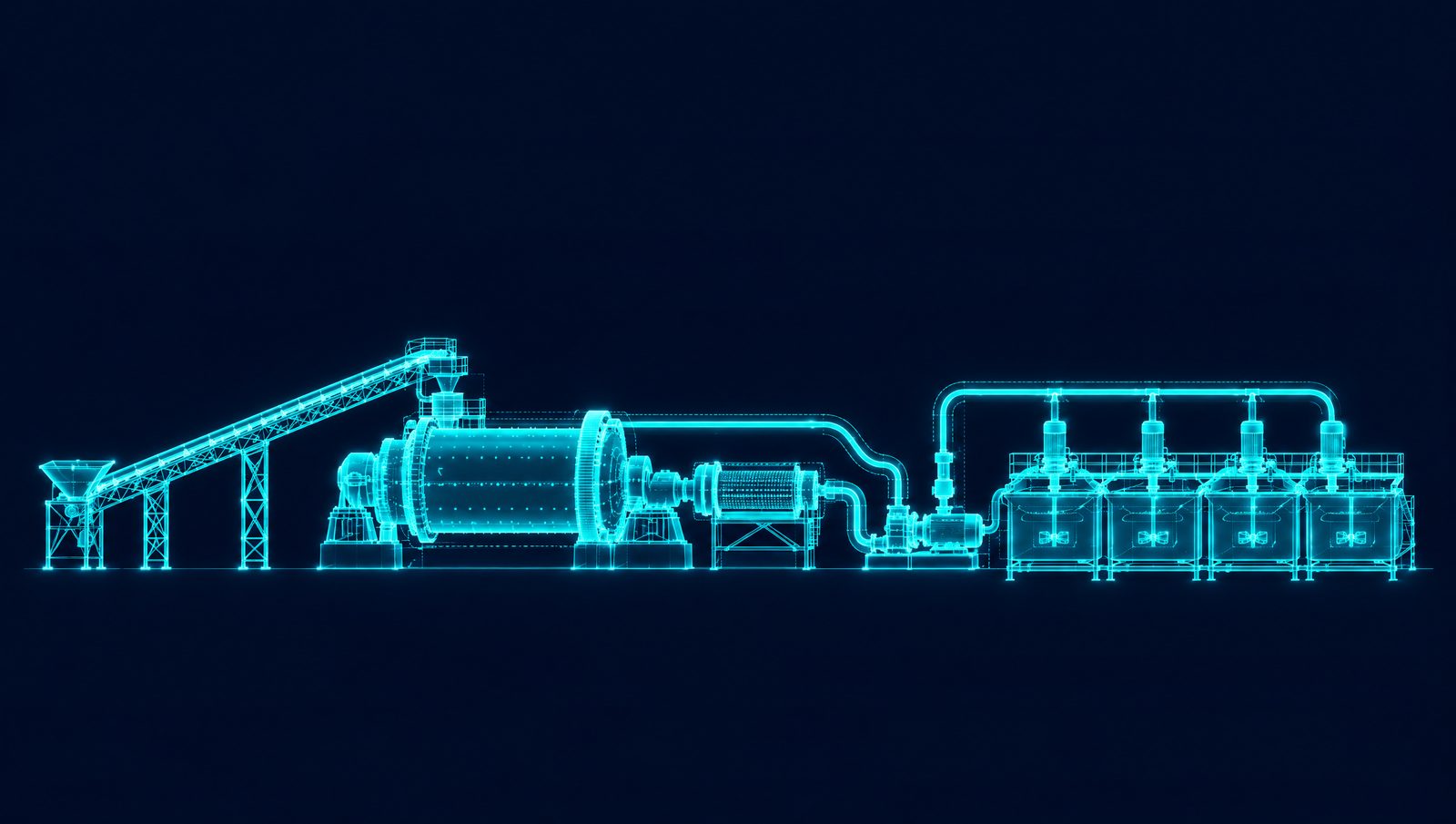
Crushing, grinding, flotation and separation involve thousands of interacting variables, dynamics that shift by the hour, and ore that changes with every blast. Conventional advanced process control (APC) handles some of these variables in isolation. It was not designed to coordinate a whole circuit or to adapt quickly when feed conditions change.
Ore variability is the core constraint. One blast can change feed hardness, moisture and mineralogy within hours. Experienced operators compensate with conservative setpoints. Those margins protect against upsets, and they give up throughput and recovery to do it.
The gap between actual performance and what the plant could achieve under tighter control is large. Because the margin erodes gradually, it rarely shows in daily reporting. The plant appears to run well and KPIs stay within their bands, while the distance between acceptable and optimal compounds over every shift, campaign and quarter.
Control systems also work in silos. The grinding circuit targets one set of parameters, flotation runs independently, and maintenance schedules are set without visibility of their effect on overall plant performance.
When grinding pushes throughput, it can send coarser particles downstream. Flotation then compensates with higher reagent dosing and longer retention times. When recovery dips, root-cause diagnosis is slow and departments blame each other. Neither system sees the full picture, and no operator, however skilled, can hold hundreds of process relationships in mind across a whole circuit at once.
How a learned model closes the gap
A learned model approaches the circuit differently. It learns how the circuit behaves from its own operating history, guided by first principles. Where a conventional controller holds a SAG mill at a fixed power-draw target, the model learns how specific ore blends, moisture levels and particle size distributions interact.
It then adjusts mill speed, water addition and crusher gaps together, and balances throughput, energy use and downstream product quality as one problem.
The effects carry through the circuit. Tighter grind-size control gives flotation a more consistent feed, which improves cell performance and reduces reagent consumption. Lower reagent use means cleaner tailings and lower chemical cost.
When a harder ore blend enters the circuit, the model does more than react at the mill. It anticipates the downstream effect on flotation recovery and sets grinding intensity to protect the overall economic result. Conventional controllers are not built to coordinate across unit operations in this way.
Real-time flotation adjustment
Flotation is more complex still. Reagent dosing, air injection rate, froth depth and cell-bank configuration all interact with ore mineralogy, and those interactions shift through a campaign. An operator watching froth cameras and grade analyzers can manage a few of these relationships at a time.
A model trained on plant data learns all of them together and adjusts parameters in real time to hold recovery at its best. When ore composition shifts partway through a campaign, a well-trained model adapts within minutes instead of waiting hours for lab results. At a copper or gold operation, even a small gain in metal recovery can be worth millions in annual revenue.
Where operators still lead
This works in practice because of the division of labor between people and the model. The model handles the multivariate complexity that even veteran operators struggle to track across a whole circuit. Operators handle the judgment a model cannot replicate.
An operator knows when conditions are unusual enough to override a recommendation, hears equipment sounds that instruments miss, and recognizes when a feed change calls for caution the model has not yet learned.
Building workforce capability alongside AI
The talent gap in mining is getting harder to ignore. According to the Society for Mining, Metallurgy and Exploration, more than half of the U.S. mining workforce, roughly 221,000 workers, is expected to retire by 2029. That retirement wave takes decades of institutional knowledge with it.
AI does not solve this on its own. It can speed up how new operators build competence, and it can preserve the decision logic experienced teams have developed over their careers.
Models built from recorded plant behavior double as training tools. New operators can work in a simulation that reflects how their own unit behaves and practice scenarios offline before touching live equipment. Instead of learning through years of trial and observation alone, they see how the plant responds across a range of ore types, feed conditions and operating strategies.
Shared visibility across departments
Coordination across departments also improves when teams share one model of plant behavior. When maintenance, operations and planning can see how their decisions affect one another, discussions move from competing opinions to a shared, data-grounded view. A maintenance deferral that affects grinding stability becomes visible to the planning team. An economic target from the LP model becomes visible to the console operator.
From advisory mode to closed loop
Plants that start in advisory mode, where the model recommends and operators decide, build trust step by step. Teams use this stage to run what-if analysis when constraints conflict, keep operation consistent across shift changes, and track process degradation to inform maintenance timing. Operators compare the model's recommendations with their own instincts and build confidence at their own pace.
Advisory mode is a step toward closed loop. In closed loop, the model writes setpoints within limits the operators set, and the operating team keeps override authority. Over time the deployment works as a workforce development program as much as a technology project, with collaboration between people and AI strengthening at each stage.
Where Imubit fits
In mining, minerals and metals, Imubit applies Map, Model and Control to the processing plant. Map traces recovery, energy and reagent losses to the recurring decisions behind them. Model uses Deep Learning Process Control® (DLPC®) to learn a nonlinear dynamic model of the grinding and flotation circuits from their own history, guided by first principles. Control takes the critical setpoint decisions to closed loop, on top of the existing APC and DCS and, inside limits set by plant engineers. Imubit's published mining, minerals and metals results are a 1 to 3% metal-recovery improvement, 5 to 10% grinding-energy savings and a 2 to 5% throughput increase.
Frequently asked questions
How does a learned model differ from conventional APC in mineral processing?
Conventional APC runs on predefined models that assume linear relationships among a limited set of variables. A learned model captures the nonlinear interactions among ore characteristics, equipment condition and process conditions from plant data. It adapts as conditions change, instead of needing manual retuning when ore types shift or equipment degrades. It works on top of the existing APC and sets the targets APC works toward, which tightens control across the full comminution and flotation circuit.
Can a plant start before handing setpoints to the model?
Yes. Most deployments begin in advisory mode, where the model generates recommendations and operators decide whether to apply them. This builds trust step by step and supports decision-making, operator training and visibility across functions. Plants move toward closed loop at their own pace, with operators able to override at every stage.
What role does AI play in the mining skills gap?
Models built from plant data serve as training tools that help new operators build competence faster. Simulations let newer team members practice the scenarios their own unit faces, instead of relying on years of on-the-job observation alone. A shared model also keeps the decision logic of experienced operators in the system. That knowledge supports operational excellence in mining as veteran staff retire.