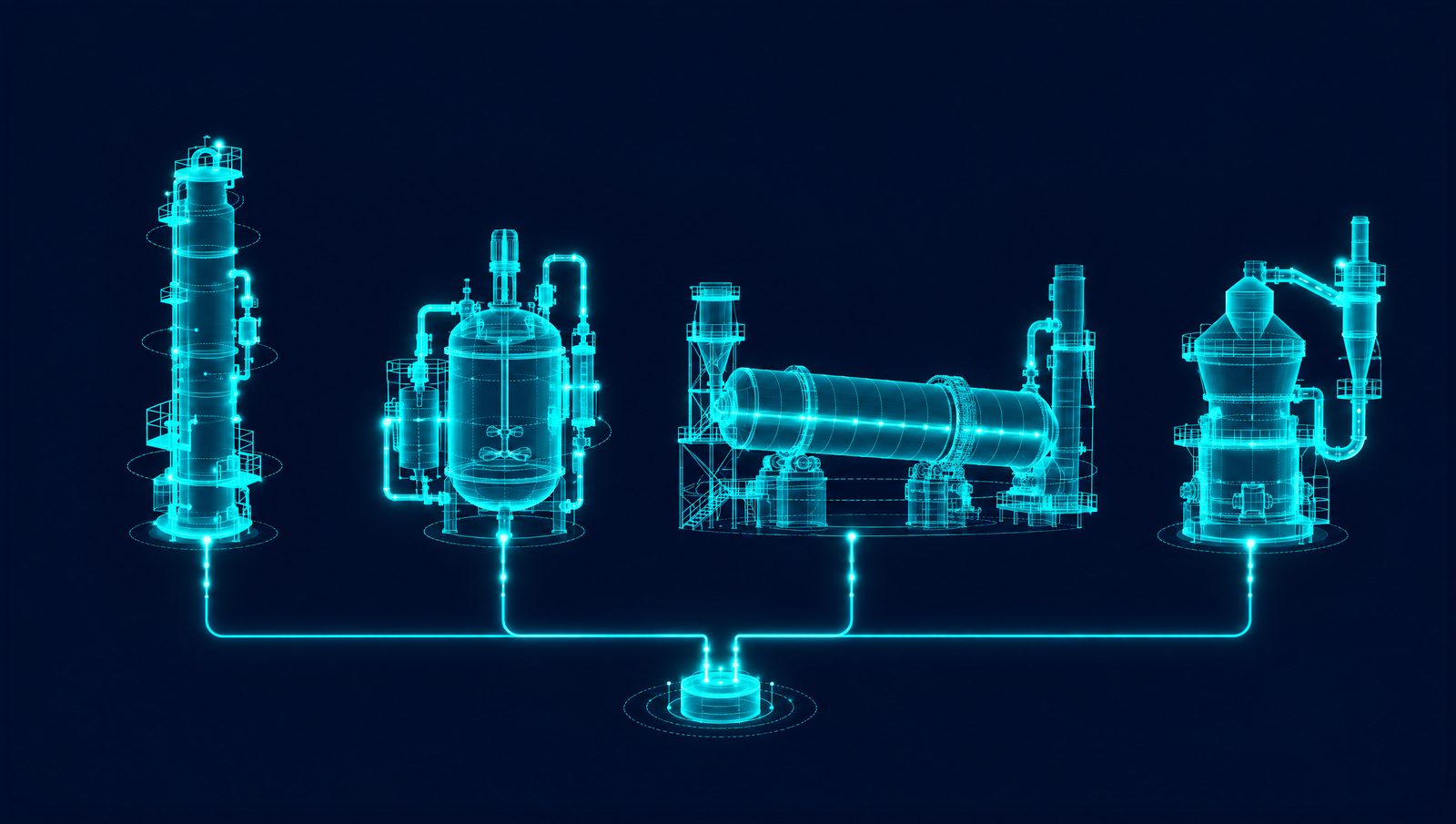
Process industry leaders usually name high initial cost as the main reason they hesitate to move AI beyond proofs of concept. The friction is rarely financial alone. The more common pattern is that plants underestimate the time needed for operator training and lack agreed metrics to judge success across departments. Culture and organizational structure often stall projects more than cost or tools do.
The result is a familiar productivity paradox, where output dips before the long-term improvements from AI appear. What looks like a technical roadblock is often an organizational constraint: misaligned KPIs, siloed data ownership, or resistance from experienced operators who feel sidelined.
Each of the five barriers below has a practical remedy.
1. The perfect data trap
Waiting for clean, fully labeled data feels prudent, but it delays the return on the project. Data quality and availability are widely ranked among the top obstacles to automation, even though most plants already collect large volumes of sensor readings, lab results and historian logs every day. The data is rarely in one place or one format.
Siloed control systems, mismatched timestamps and long gaps in historical tags leave blind spots in the variables a model needs to learn. In refineries and chemical plants, those gaps can hide heat balance shifts or catalyst degradation patterns that a learned model could otherwise expose.
The better approach is to let the data and the models improve together:
- Start a focused pilot on the data streams that already exist.
- Launch data governance in phases alongside it.
- Use the early models to find bad tags, and clean them up before the next training cycle.
Each cycle sharpens the next one. For how plants turn that work into returns, see how AI drives ROI in smart manufacturing.
2. Cultural resistance framed as technical objections
When a plant team says its hydrocracker is too unique for AI, the objection often covers deeper concerns about job security and operational control. Many stalled projects trace back to culture and change management, even when they are described as technical constraints.
Work on organizational readiness for AI shows that trust and psychological safety become critical in environments built around safety. Plants with a culture of experimental learning tend to see both better performance and stronger engagement. When front-line teams feel secure enough to test, question and iterate, adoption follows.
Two practices help most:
- Transparent operator training, where teams can examine the model directly and see how it responds to the moves they would make.
- Recognition of joint successes, where operators and the model together handled a situation better than before.
Both build the psychological safety that sustained adoption depends on.
3. Misaligned success metrics
Few organizations work from a single, agreed set of metrics. In a typical refinery, operations pushes for higher throughput, maintenance watches equipment uptime, IT tracks model accuracy, and finance looks at margin per barrel. Each team works in its own systems and on its own rhythm.
When those measures differ, AI pilots drift into scope creep because no one can prove value in common terms. Dashboards tell different stories, meetings turn into debates over whose numbers count, and projects pause while leaders ask for another ROI analysis. It is the same fragmentation that shows up across the plant as a gap between the plan and what the units deliver.
Aligning the work to clear P&L levers, capturing a baseline before the pilot, and showing results on shared real-time dashboards turns that friction into progress. Balanced scorecards connect softer goals such as operator trust with hard targets such as energy intensity, so each department sees its result in the same frame.
Plants that get this right usually:
- Form a cross-functional steering committee with clear decision rights.
- Hold a KPI agreement workshop before any modeling begins.
- Publish a live dashboard of the agreed metrics to everyone from the console operator to the CFO.
When the whole plant reads from one shared model instead of separate spreadsheets, the project stops being one team's initiative and becomes how the business measures performance.
4. The pilot scope paradox
Some pilots are so constrained they cannot move the needle. Others are so broad they collapse under their own weight. The usual cause is scope rather than the algorithm.
A narrow test bed cannot capture the real variability of a refinery. An over-ambitious rollout strains data pipelines, change management capacity and operator trust. Getting from a promising demonstration to a system in daily use takes a view that covers the technology, the data and the culture together.
Pilots that land in the right range usually share three choices:
- A high-visibility unit with material financial upside.
- A limited set of variables, so the team can isolate cause and effect.
- A results window agreed in advance, after which the learnings are locked in for scale.
A modular platform lets the team add units without rewriting the work already done, and a cross-functional team keeps operators, IT and finance aligned as it grows.
5. The integration timeline misconception
Connecting to the historian is the quick part. The real integration clock starts when operators begin to trust and use the model. Project schedules often budget hours for IT work and pass over workforce readiness, as if machine learning were plug-and-play.
Industrial models need continuous monitoring and retraining, and many companies lack the expertise to keep them healthy after launch. Legacy equipment makes planning harder. Data has to pass through DCS layers, older protocols and strict cybersecurity boundaries before it reaches the model. Each hand-off adds latency, version-control risk and maintenance work, the model operations tasks that rarely appear in the original schedule.
The longer path pays off when human adoption is treated as the critical path. Plants that succeed with closed-loop optimization understand that operator confidence matters more than connection speed. Training builds the trust that the results depend on.
To keep the schedule realistic and the return intact:
- Set operator training milestones alongside the technical milestones, and track both.
- Budget model maintenance from the start, so models keep pace with changing feed slates and equipment condition.
- Review model performance on a fixed cadence against plant KPIs, and capture new data for retraining.
How the Imubit Platform applies
Imubit works through these barriers with plant teams in refining, chemicals and polymers, cement, and mining and minerals. On the Imubit Platform, Map traces plan-to-plant gaps to the recurring decisions behind them, so operations, engineering and planning work from one view of each decision and its constraints. Model learns each unit's causality from the data the plant already holds with Deep Learning Process Control® (DLPC®). Control takes the critical decisions to closed loop on top of the existing APC and DCS, at a pace the plant team sets. See how the platform works.