Archive: market commentary from 2022, written by Imubit's Economic Engineering team. Capacity figures, forecasts and announced plans reflect conditions at the time.
Summary
Over the two years before this update, the coronavirus pandemic and an existing push toward renewables changed the economics of refining. From 2019 to 2022:
- Operable U.S. refining capacity fell by about 1,040,000 bpd, or 5.5%, according to the EIA Short-Term Energy Outlook (STEO).
- Fuels demand returned to levels comparable to or higher than 2019.
- Refiners were unwilling to invest in capacity debottlenecks, because of shareholder ESG (environmental, social and governance) demands or government policy.
Together these created an unusual situation. Given what was known at the time, it was reasonable to expect a prolonged up-cycle in refining, driven by a capacity shortage that would not be resolved quickly. Russia's war in Ukraine magnified this in the near term. Much of Russia's refining capacity became effectively unavailable as western nations shunned or sanctioned Russian refined products and crude.
In earlier periods of high margins, investment in new refining capacity followed, although crack spreads at the time of writing were wider than in any of those periods. This time, investment from publicly held companies looked much less likely, because of ESG investing and activist investors. The planned capacity additions we knew of were all in the eastern hemisphere. Those barrels would need a wide arbitrage to reach the U.S., another factor likely to support U.S. refining spreads for some time.
Refining capacity lost
The U.S. refining industry lost several sites during the pandemic downturn, and the closures totaled more than 1 million bpd, as Figure 1 shows. Figure 2 lists the sites and what led to their closure or planned closure as refineries. Some were being repurposed as terminals or renewable diesel units, at much lower capacity and with bio-oil feedstocks still to secure.
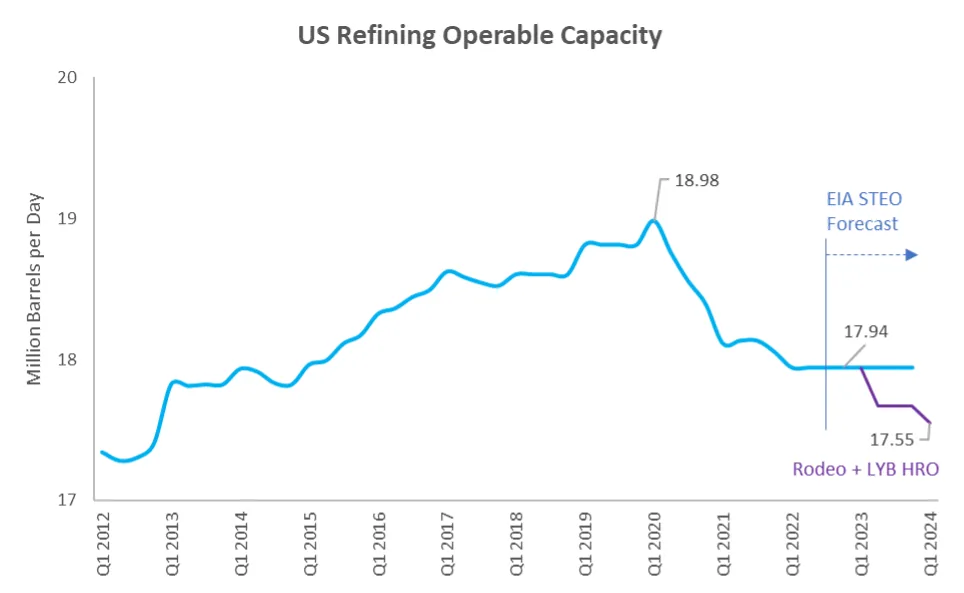
Figure 1: Since Q1 2020, more than 1 million barrels per day (5.5%) of operable U.S. distillation capacity has been lost. Source: EIA Short-Term Energy Outlook 2022.
| Site | Crude capacity (bpd) | Closure reason or plans |
|---|---|---|
| Alliance, Louisiana | 250,000 | Hurricane damage and economics; no buyer found to operate it, so it is being reused as a terminal |
| Philadelphia, Pennsylvania | 335,000 | A process safety incident and economics; the purchaser plans to redevelop the site, possibly for non-industrial use |
| Convent, Louisiana | 211,146 | Economics during Covid and the owner's stated move away from refining; no buyer found to operate it |
| Martinez, California | 161,000 | Economics during Covid and ESG pressure; conversion to a terminal and renewables |
| Cheyenne, Wyoming | 48,000 | Conversion to renewable diesel |
| Gallup, New Mexico | 27,000 | Not disclosed, presumably economics during Covid |
| Dakota Prairie, North Dakota | 19,000 | Economics and conversion to renewable diesel |
| Houston, Texas | 268,000 | Planned shutdown in 2023 if not sold, per the owner's press release, as the owner focuses on chemicals and polymers |
| Rodeo, California | 120,000 | Planned conversion in 2024 to renewable diesel alone |
| Total, including announced future shutdowns | 1,439,000 |
Figure 2: U.S. refinery closures from 2019 to the time of writing, including two announced future shutdowns. Sources are linked in the table.
The war in Ukraine also changed how distillates and crude are supplied around the world. That was likely a transient but long-lasting effect on refining margins, on top of an already tight supply situation. The EU greatly increased its demand for U.S. crude and distillate exports.
Demand returned and kept growing
In the 2022 EIA STEO, fuels demand returns to and exceeds pre-Covid levels by 2023, as Figure 3 shows, despite aspirations for electrification. Refining capacity, meanwhile, was much reduced by closures and conversions. Renewable diesel would make up part of the lost fuels production, but a renewable unit's capacity is usually a fraction of the crude capacity of the refinery it was converted from.
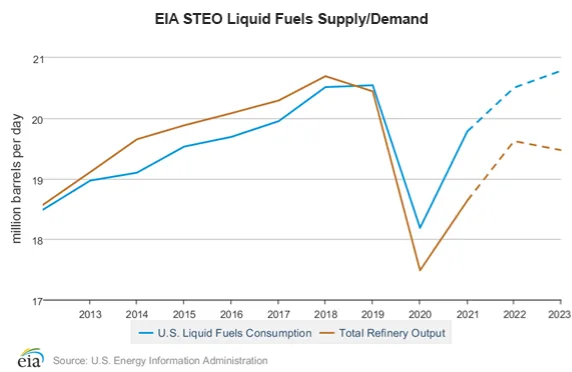
Figure 3: Total U.S. refinery output falls below U.S. liquid fuels consumption from 2019 onward. The projection does not include the potential Houston and Rodeo shutdowns. Source: EIA STEO 2022.
Basic economics says the gap in Figure 3 cannot hold when there are limited sources of imports to fill it. The U.S. was in fact a significant exporter of fuels to Latin America, and at least temporarily to the EU. Product prices would have to rise far enough to destroy some elastic demand and bring it in line with the available supply. That environment favored margins above typical levels.
Running existing units for the margin
When refining capacity is short and margins are wide, each barrel that existing units can process and upgrade is worth more. Imubit's Deep Learning Process Control® (DLPC®) learns each unit's behavior from its own operating history. It runs in closed loop on top of the existing APC and DCS, inside limits set by plant engineers, and moves crude and conversion units toward current economics minute by minute.