Archive: market commentary from September 2020, written by Imubit's Economic Engineering team. Prices, inventories and forecasts reflect conditions at the time.
This was the first in a monthly series on hydrocarbon markets and economics, covering transportation fuels (gasoline, diesel and ethanol), chemicals, crude oil, natural gas and ammonia. The team brought refining and chemicals planning, economics and coordination experience from settings that ranged from the field to the trading floor.
The first topic was the one on everyone's mind: how the Covid-19 pandemic disrupted supply and demand in almost every hydrocarbon processing business, from upstream through refining and chemicals, and how processors were adapting. The effects were global. This analysis focuses on the U.S. market.
Refining and fuels
Refiners were hit hard. They went from maximizing rates on healthy margins to cutting back to 70 to 80% capacity utilization, with near-zero and negative margins, as jet fuel demand fell away in the EIA's weekly data. Most of the jet was sunk into the diesel pool. That raised ULSD production at the same time that exports to other regions fell with GDP, and distillate stocks built heavily even as refiners balanced gasoline production. The EIA published a useful summary of the changes refiners made. Beyond operating adjustments and optimization, refiners also idled facilities and shut some down permanently.
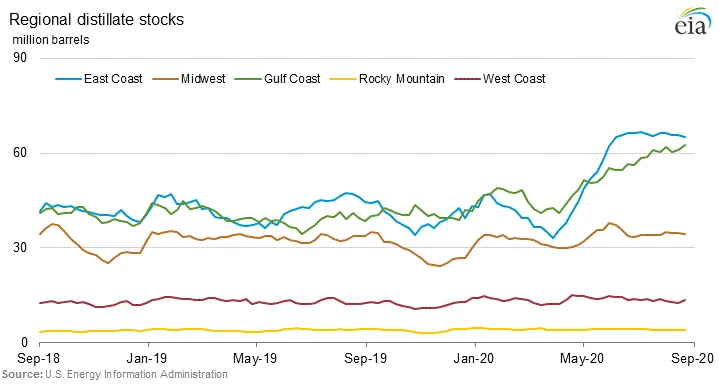
Regional distillate stocks, million barrels. Source: EIA.
Gulf Coast (PADD 3) inventories continued to rise, because refiners were still producing more distillate than the market needed, with jet downgraded into diesel even at reduced rates. East Coast (PADD 1) inventories can be read as an extension of PADD 3 storage, since pipelines connect the two. EIA data put U.S. distillate inventory at about 50 days of demand, against about 35 days a year earlier. Gasoline inventory stood at about 27 days of demand, against about 24 days a year earlier.
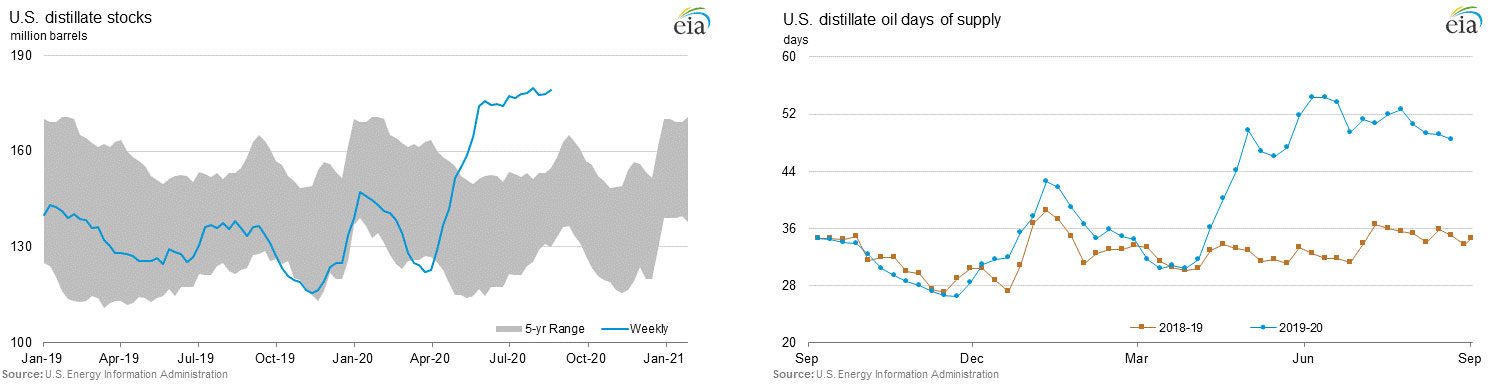
U.S. distillate stocks against the five-year range, and distillate days of supply. Source: EIA.
Why refiners did not raise conversion
There was little incentive to. The market stayed disconnected from the physical balance, with ULSD prices holding close to gasoline, and at times above it, despite a much higher and still rising distillate inventory.
It was hard not to conclude that ULSD prices were being held up by speculation and contango storage plays. As physical storage for ULSD reached its limits, ULSD prices would need to fall far enough to give refiners the incentive to move more aggressively toward high-conversion operation and lower crude inputs. Refiners that could re-optimize their units quickly would be in the best position to capture that change when it came.
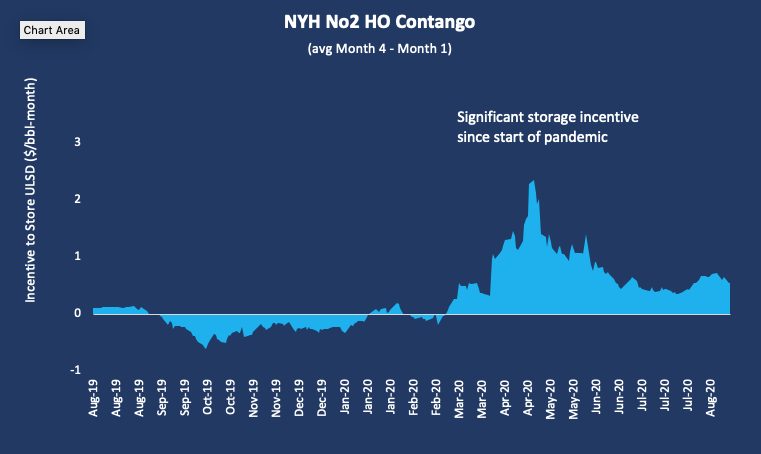
New York Harbor No. 2 heating oil contango, the incentive to store ULSD. Data: EIA.
Chemicals
As the pandemic progressed, demand for some polymer grades fell with manufacturing and construction activity, while demand for grades used in medical PPE and other single-use items increased, according to IHS Markit. That shifted demand for monomers such as ethylene, propylene and paraxylene in unusual ways. With improving activity, olefins producers saw some relief in margins.
What it means at the unit
When a market like this corrects, the response happens unit by unit: crude rate, conversion and the balance between distillate and gasoline all have to move to the new economics. In refining, Imubit's Deep Learning Process Control® (DLPC®) models learn each unit's behavior from its own operating history and run in closed loop on top of the existing APC and DCS, inside limits set by plant engineers, adjusting the unit to current economics minute by minute.