This post is from our 2020 to 2021 Economic Engineering series of refining market commentary. It reflects market conditions in November 2020.
A second wave raises the risk for refiners
COVID-19 cases rose sharply again in the U.S. and globally through October and early November 2020. In the first wave, the main tool governments had to slow the spread was lockdown, which cut economic activity and energy demand. As daily cases climbed again, some governments were returning to the same measures, such as the second national lockdown in the UK reported by BBC News.
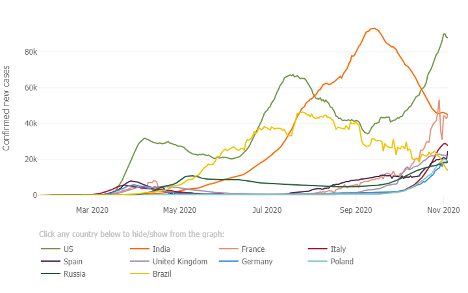
Figure 1: Confirmed new cases were trending up in many countries in late 2020, raising the risk of further shutdowns. Source: Johns Hopkins University.
There was some reason for more optimism than in the spring. The spread of the disease was better understood, most communities had mask mandates, and not every country seeing a rise was expected to return to the kind of lockdowns seen in April. Vaccinations were also expected to begin in some countries, possibly within a month.
Still, the spread was real, and measures that reduce transportation fuel demand were likely. For refiners that meant a return to, or a longer stay at, lower utilization rates, and continued weak incentive to run outside the conversion tiers.
Regional utilization
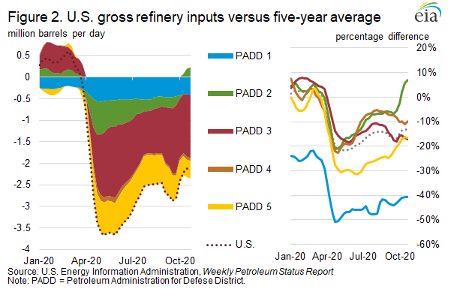
Figure 2: U.S. gross refinery inputs versus the five-year average, by PADD. Source: U.S. Energy Information Administration, Weekly Petroleum Status Report.
PADD 2, the U.S. Midwest, was running above its five-year average for the time of year. Its supply of local markets, the fall harvest and closer access to Canadian heavy crude were likely behind that. Gulf Coast (PADD 3) refiners have to pay pipeline tariffs in both directions to supply the Midwest market, which gives PADD 2 refiners a degree of protection.
Turnarounds and capacity
If demand returned to the lows of April and May 2020, some refineries could shut down for extended turnarounds. Many had already deferred maintenance, but deferred work forces a turnaround at some point. Depending on the medium-term outlook, further capacity rationalization was also possible.
Gasoline and diesel
How gasoline and diesel demand would move relative to each other was an open question. Harvest season and the loading of floating storage were supporting diesel at the time, and in winter diesel generally runs above gasoline because of heating oil demand and lower gasoline demand. The risk for diesel is that its demand trends with GDP, so it would weaken if economies dipped again.
Where yield optimization still pays
Refining margins were expected to stay low and volatile. Yield optimization is worth less when product spreads are narrow. The value is still there, and it moves more often. Some optimizations are always in play, such as FCC volume gain and hydrocracker yield. When octane is not highly valued, holding reformer octane at the minimum needed to make feasible gasoline blends returns more barrels of sellable product, or the same product from less refinery input.
These trade-offs shift with prices and with the condition of each unit, which makes them a good fit for closed-loop control on the units themselves. Imubit's Deep Learning Process Control® (DLPC®) learns each unit's behavior from its own operating history and writes setpoints to the existing APC or DCS minute by minute, inside limits set by plant engineers, so the operating point follows the economics as they change. For more on these units, read about FCC unit operation and hydrocracking yield optimization.