Oil and gas operations carry a large share of energy-sector greenhouse gas emissions, and the pressure to decarbonize meets the reality that production has to continue. Regulators and long-term investors now expect verifiable, year-over-year reductions. Member companies of the Oil and Gas Climate Initiative, for example, set a target of 17 kg CO₂e per barrel of oil equivalent for the aggregate carbon intensity of their upstream operations by 2025, and OGCI reports that they reached 17.2 kg in 2024.
The technology that improves margins can also help meet those targets. Much of an operation's emissions come from fuel burned in heaters, boilers and compressors, from methane that leaks or is vented, and from flaring during upsets. Each of those sources can be reduced with better use of the data the plant already collects.
Cutting emissions without cutting margin
Retrofitting equipment, switching to lower-carbon fuels or installing carbon capture all need capital, and capital is hard to commit when refining margins swing sharply from one quarter to the next.
Models layered onto existing control systems offer another route. Instead of a multi-year construction project, data models built from plant history get more out of the boilers, compressors and heaters already in place.
Many efficiency programs stop at cost savings and never quantify the CO₂ they avoid. Because fuel and power use convert directly into emissions, the same energy improvements can be reported as carbon reductions that hold up in an ESG disclosure.
The four approaches below cover the main emission sources.
1. Real-time process optimization
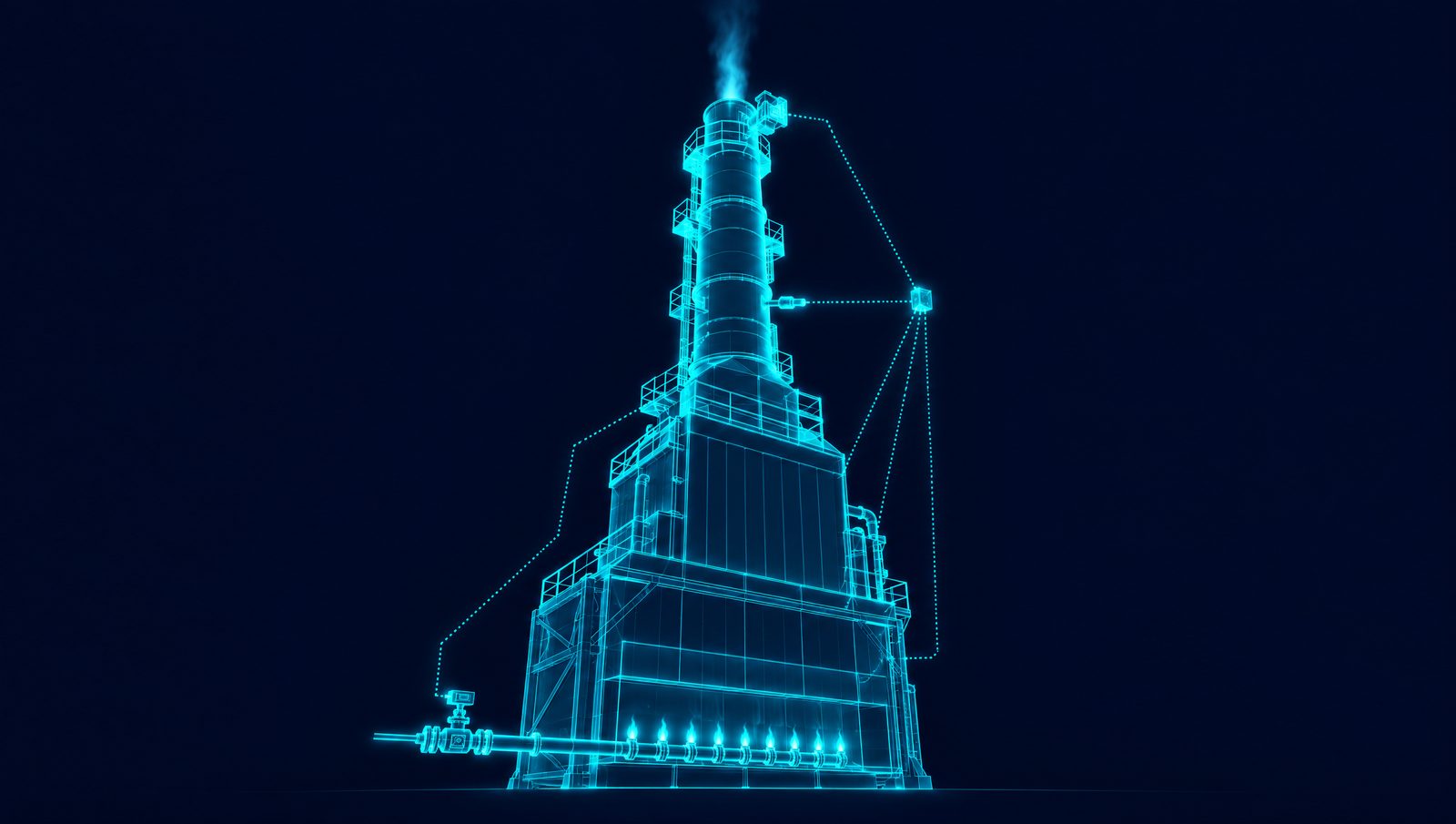
A closed-loop controller learns from historian, lab and sensor data how valves, heaters and compressors interact across a unit, and writes setpoints back to the distributed control system (DCS), inside limits set by plant engineers. Continual adjustment toward the economic optimum reduces the energy burned per barrel, which lowers Scope 1 and Scope 2 emissions directly.
The model can pick up inefficiencies that are hard to see from the console: small pressure imbalances that waste fuel, or a drift in catalyst activity that leads operators to fire a heater harder than the process needs. Correcting those every minute, instead of at the next review, lets the plant optimize around energy, margin and emissions together.
2. Leak detection and methane monitoring
The Intergovernmental Panel on Climate Change puts methane's warming effect at roughly 80 times that of carbon dioxide over a 20-year period, so every undetected leak costs both climate performance and product. Traditional leak surveys happen a few times a year and miss short-duration events.
Machine learning models can combine satellite imagery, fixed sensors and mobile monitoring and scan those data streams continuously for the signature of a methane release. Continuous monitoring shortens the time between the start of a leak and its repair, and helps operators send repair crews to the largest releases first.
Faster detection recovers product that would otherwise escape, reduces safety incidents and supports emissions disclosures that regulators and investors can verify.
3. Energy management across the site
Site-wide energy management takes a broader view than a single unit. It brings together data from across the facility to find savings between interconnected systems, coordinating boilers, compressors and any onsite renewable generation.
Typical measures include shifting loads, recommending changes to heat integration, managing grid interaction and removing energy waste between units. Lower electricity use translates directly into lower Scope 2 emissions.
4. Predictive maintenance that prevents emission spikes
Equipment failures stop production and also trigger emergency venting and flaring. When a pump seal fails or a compressor bearing seizes, operators often have no choice but to flare or vent to prevent a larger incident.
Predictive maintenance models read vibration, pressure and temperature data from critical equipment and detect the early signs of failure. That lets maintenance teams plan repairs during steady operation, when emissions can be controlled, instead of responding to an emergency that forces a flare.
What this means for operators
Plants that can show lower energy use and emissions per barrel are in a stronger position with regulators, investors and offtake customers. All four approaches work with equipment already in place, so none of them has to wait for a capital project.
How the Imubit Platform applies
Of the four approaches, closed-loop process optimization is where the Imubit Platform works, on energy-intensive units in refining and gas processing. Map traces excess fuel and power use to the recurring decisions behind it, such as heater firing, steam and compressor targets. Model learns each unit's nonlinear behavior from its own history with Deep Learning Process Control® (DLPC®). Control takes those decisions to closed loop, inside limits set by plant engineers, writing setpoints to the APC or DCS already in place. Where energy is the optimization target, deployments have delivered a 15 to 30% reduction in energy consumption.