By Roger Wilhelmi, Imubit
Why renewable diesel is growing
A central question for refiners over the coming years is how to move to lower-carbon operations. Europe started early, with several refiners committing large capital programs to decarbonization. In North America, existing ESG incentives combined with the credit expansions in the Inflation Reduction Act (IRA) give producers more financial security when they invest in clean fuels technology to meet net-zero goals. As RSM's summary of the IRA's clean fuel incentives explains, the act extends a credit system similar to California's Low Carbon Fuel Standard nationwide, with the highest incentives going to fuels with the lowest carbon intensity (CI).
Moving into renewable fuels production is a promising way to lower the carbon footprint of refining. Electrification is reducing projected demand for liquid fuels in light-duty vehicles, but there is no clear winner yet for heavy-duty diesel transport. A mix of technologies will power that fleet, as the U.S. Department of Energy's Alternative Fuels Data Center shows, and no replacement for petroleum diesel can be brought in faster than drop-in renewable diesel.
Renewable diesel (RD), also called hydrogenated vegetable oil (HVO) or hydrogenation-derived renewable diesel (HDRD), will be a major area of growth over the coming decades as refiners, biofuels producers and new entrants work to decarbonize liquid fuels. Some of the earliest producers, Neste and Diamond Green Diesel among them, installed significant capacity as early as 2007, and more is on the way. Several large North American refinery retrofits that convert existing units to renewable feeds have been announced in recent years.
Why the unit is harder to run than it looks
At first glance the step looks straightforward: modify existing equipment and process renewable feedstocks to lower the carbon footprint. Producers who have made the move know that execution is harder. Feed composition, ambient conditions and catalyst activity are usually unmeasured, and as they change, so do the operating conditions that maximize the value of the unit. That holds whether renewable feeds are coprocessed with petroleum feed or processed alone.
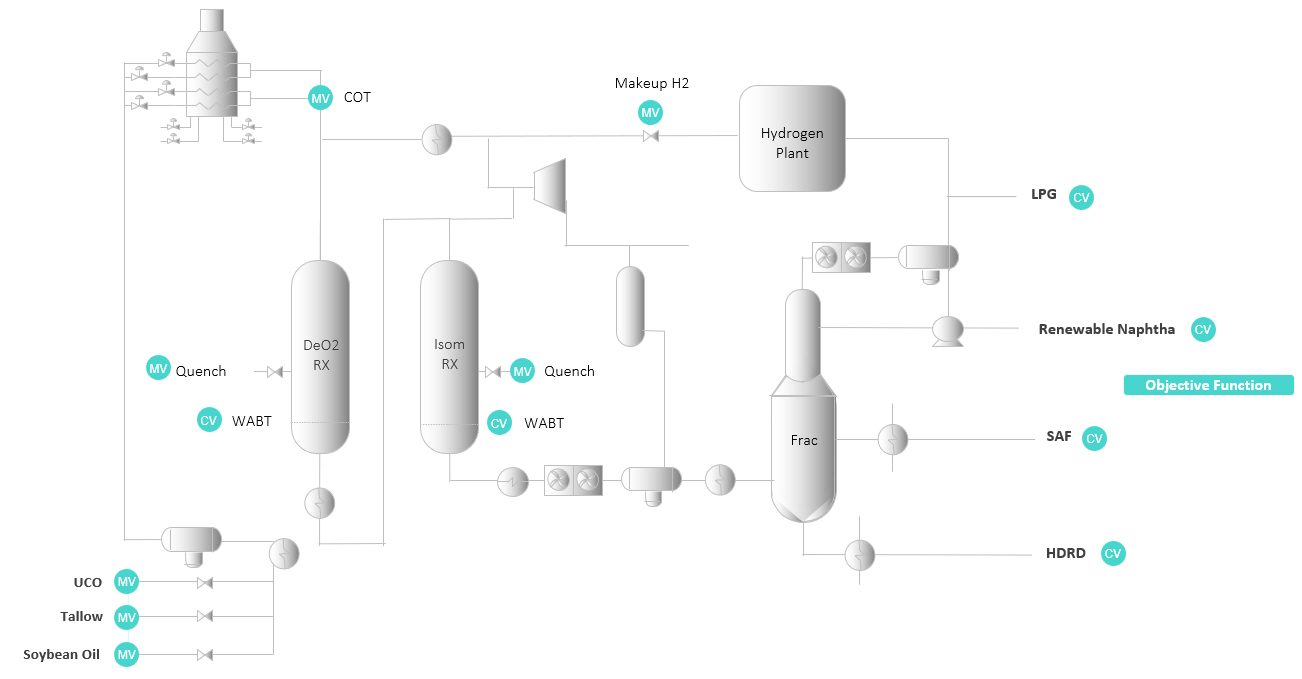
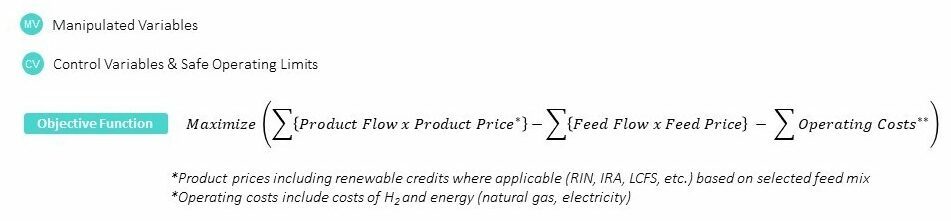
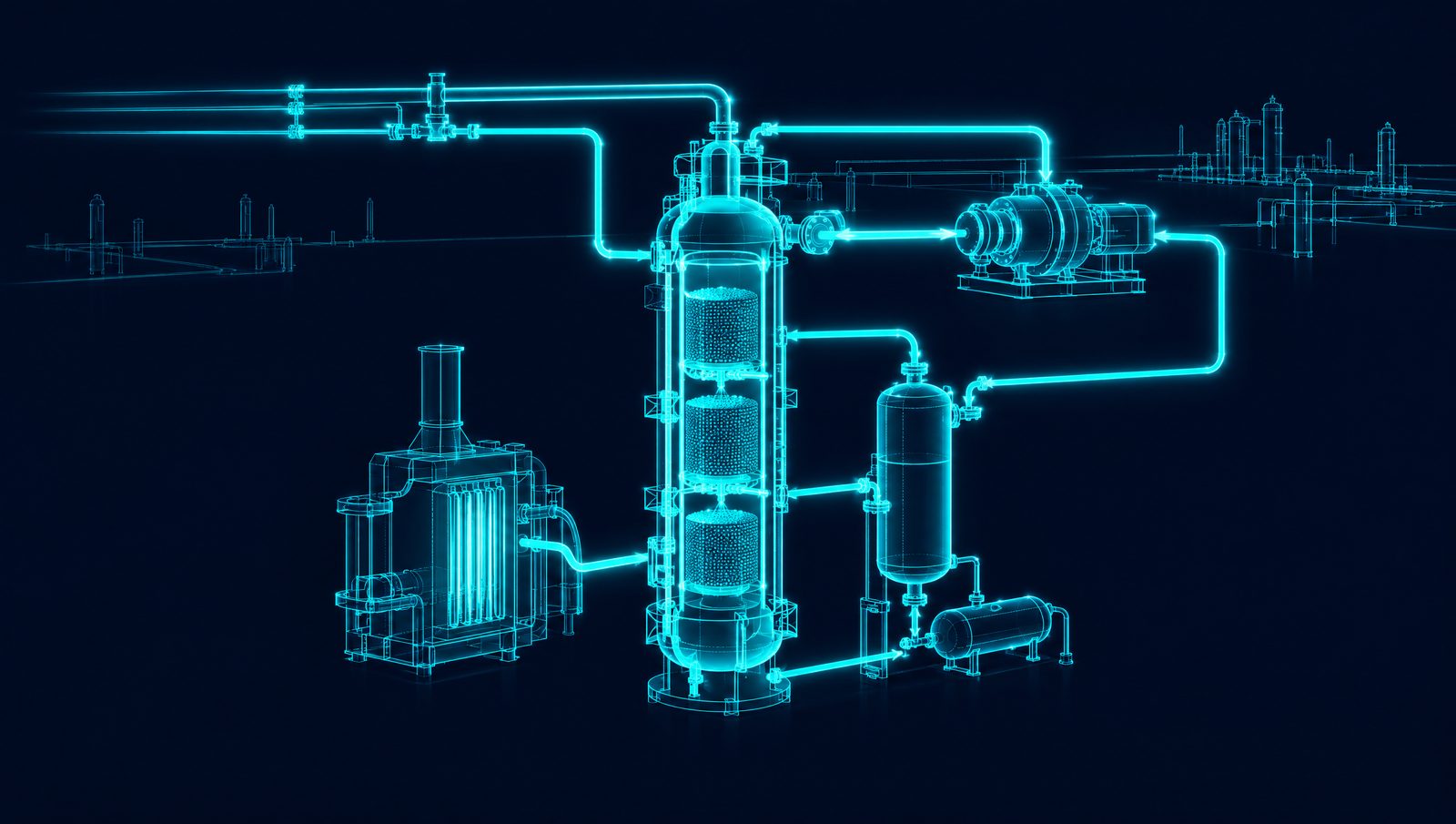
Figure 1. Closed-loop optimization of a renewable diesel unit with multiple feed types. The controller writes setpoints to the manipulated variables (MVs) and keeps the control variables (CVs) within safe operating limits while maximizing the objective function.
The objective function is total product value, minus total feed cost, minus operating costs. Product prices include renewable credits where they apply (RIN, IRA, LCFS), based on the selected feed mix. Operating costs include hydrogen and energy, such as natural gas and electricity.
What the optimization has to balance
Renewable feeds bring new challenges that call for dynamic optimization of process parameters. Process severity should be set to:
- Balance renewable diesel and sustainable aviation fuel (SAF) coproduction against contractual obligations or the economic optimum
- Achieve enough isomerization and dewaxing of paraffinic molecules to meet cold flow property specifications, while minimizing over-cracking to lower-value naphtha and LPG
- Minimize the operating costs of renewable feedstock processing, such as energy use and hydrogen consumption
The problem becomes more complex for producers that can acquire and process variable feed sources. The optimal feed slate has to account for:
- The price of each feed type
- The CI of each feed type and the tax credits associated with it
- The expected yield structure and volume swell of each feed, and how they vary with process severity (WABT)
- How to maximize the incremental value of renewable and petroleum feeds within safe operating limits
Where closed-loop control fits
Refineries have long relied on process optimization to maximize economic output. Incentives that reward low CI make the plant optimization problem more complicated still. Optimizing a process like this takes a deep understanding of the process relationships and a way to search a large, nonlinear solution space.
Reinforcement learning can drive a renewable unit toward its economic optimum on a continuous, minute-by-minute basis. Refinery conversion units already use it to maximize profitable yields as feed composition, catalyst selectivity and other process relationships change. Deep Learning Process Control® (DLPC®) applies the same approach here. A Deep Learning Predictor learns a nonlinear dynamic model of the unit from its own history, guided by first principles, and a Deep Learning Controller trained by reinforcement learning learns the control policy.
In closed loop, DLPC® writes setpoints for handles such as feed flows and reactor severity through the existing APC or DCS, inside limits set by plant engineers. It maximizes profitability from current prices and yields while respecting safe operating limits and product quality specifications.
About the author
Roger Wilhelmi has more than ten years of experience in the petrochemicals industry. He has worked in process engineering, planning and economics, supply chain optimization, sales and business development at ExxonMobil and at Imubit. He holds a bachelor's degree in chemical engineering from the University of Arizona.