Archive: written in 2020, when the pandemic cut jet fuel demand. Market conditions reflect that time.
The COVID-19 pandemic sharply curtailed international air travel. Demand for jet fuel, normally a high-value product and one of the easiest refined products to sell, fell to record lows, and jet crack spreads turned negative in all markets.
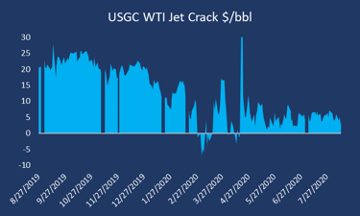
U.S. Gulf Coast jet crack spread against WTI, dollars per barrel.
Refiners started asking how to run the refinery so that it makes as little jet fuel as possible, at the lowest cost. There are two main answers, and a few further options for whatever kerosene is left after them.
Push light kerosene into the reformer and the gasoline pool
Raise the crude unit overhead naphtha end point toward the maximum the catalytic reformer accepts, typically 185°C (365°F). At the same time, increase fractionation of the crude overhead heavy naphtha to give a sharp separation up to that maximum final boiling point (FBP). In parallel, increase the kerosene side stripper steam or reboil ratio, so that the lighter naphtha-type material goes to the tower overhead and the flash point of the remaining kerosene is as high as possible.
These moves push the largest possible share of light kerosene-range material into the reformer, and from there to the gasoline pool, and leave behind kerosene with the highest possible flash point. Watch reformer catalyst coking as the moves are made. The heavier feed raises both octane and coking at the same inlet temperatures.
Cut the diesel deeper
Cut the crude unit diesel stream or streams as deep as the final diesel pool can tolerate, consuming as much kerosene as possible into finished diesel up to the flash point limit, and ideally up to a heavy-end specification (cloud point or 90% point) at the same time.
If that still does not consume all of the kerosene, make the crude tower work harder to fractionate the back end of the diesel cut more tightly, so the cutpoint can move higher still before it reaches the cloud point specification. Check that the distillate hydrotreater stripper reboil or stripping steam ratio is not set too high. Too much stripping drives the lighter kerosene-type material back to the crude unit, or to other hydrotreaters, as wild naphtha.
Options for the remaining kerosene
Reduce crude feed
Many refiners were forced to take this option. Reducing crude charge also frees capacity on the charge heater. That allows a higher coil outlet temperature (COT) and flash zone temperature, and possibly lower pumparound rates to improve diesel and residue fractionation. The higher diesel yield at constant quality can consume more kerosene into the diesel pool, so the crude rate does not have to fall as far as it otherwise would.
Convert surplus jet in the hydrocracker
By this point, hydrocrackers would already be running at high severity (gasoline mode, or naphtha for petrochemicals) or at low severity (diesel mode), with minimal jet production. Either route can work, depending on the economics of the refinery's location and its downstream configuration. With lower crude runs, room for more feed opens up in the hydrocracker. That creates the chance to crack surplus jet into naphtha, or to absorb more of it into the diesel pool and gain another fractionation step. The extra fractionation drives more of the lighter kerosene molecules out of the diesel, so the diesel can run hard against its flash point specification.
Keep the economic tiers of jet
Some refiners will find that certain tiers of jet production remain economic even at ULSD parity or lower prices, because of their configuration. One example is a refinery that lacks additional 15 ppm hydrotreating capacity but has good cracks and upgrades elsewhere that drive production of this material.
Holding the balance
If the balances between these units are identified and managed well, and final diesel quality runs tight to flash point and T90 or cloud point continuously, small adjustments to the crude charge rate help eliminate jet production or hold it to its economic tiers.
The difficulty is doing all of this at once. It means balancing feed rates across several units, several product cutpoints and fractionation objectives, product quality control and unit severities in real time, often with different parts of the value chain on different panels run by different board operators. It is a multi-unit, nonlinear, dynamic optimization problem. In 2020 the objective was less jet. When the market moves again, the objective changes and the same units have to be rebalanced.
This is the kind of problem Imubit's Deep Learning Process Control® (DLPC®) is built for. It learns a nonlinear dynamic model of each unit from its own operating history, guided by first principles, and runs in closed loop on top of the existing APC and DCS, writing setpoints minute by minute, inside limits set by plant engineers. Refining examples are on the customers page.