
Archive: market commentary from March 2021, written by Imubit's Economic Engineering team. Prices, inventories and forecasts reflect conditions at the time.
In January, the second wave of Covid-19 was weighing on refining margins again in many parts of the world. A few things have changed in the two months since, and the outlook for refining this summer is considerably better.
Vaccinations and travel demand
The US has three Covid-19 vaccines in distribution. In early March, CDC data showed more than 2.7 million doses a day being administered, and President Biden has called for vaccinations to be open to everyone by May 1.
As people are vaccinated, pent-up demand to get out and travel should lift recreational trips, even with masks and some restrictions still in place. That helps gasoline and jet demand directionally. Jet is unlikely to return to pre-pandemic levels on this alone. Much business travel has been lost and may take time to come back, if it comes back at all, because people have learned new ways to work.
The Texas freeze hits refining, petrochemicals and natural gas
In the week of February 15, Texas saw widespread blackouts on the ERCOT grid. Freeze-offs in the Permian Basin cut oil and natural gas production, and the effects reached industries well outside the state. US refinery inputs fell sharply.
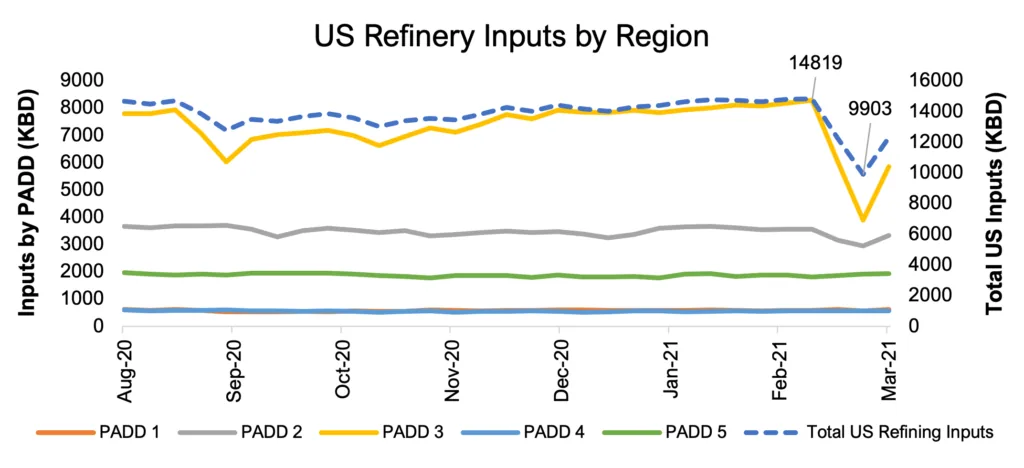
Figure 1: US refining inputs fell by 4.9 MMBPD nationwide during the Texas freeze. Source: EIA data.
On top of a drop of almost 5 million barrels per day in refinery inputs, natural gas curtailments and price spikes shut down nearly every steam cracker, along with other types of chemical plants. Any option to get natural gas and electricity back on the grid was on the table as the storm cost lives across Texas, and the natural gas shortfall also significantly affected PADD 2 in the Midwest.
With so much capacity offline, gasoline and diesel stocks have drawn heavily, as the EIA data in Figure 2 shows. The sudden fall in product stocks should position the market for higher prices. The draws have not ended as of early March and may extend through the driving season.
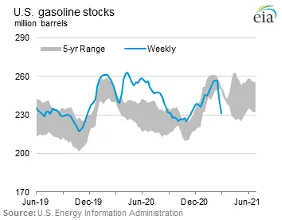
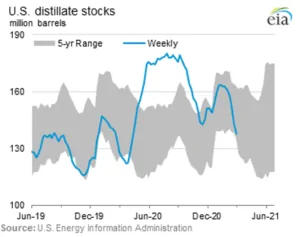
Figure 2: Gasoline and diesel stocks have drawn heavily since the freeze, and gasoline stands to start the summer well below its five-year range. Source: EIA.
The outlook for the summer driving season
Last summer's driving season was weak because much of the country was closed, especially early in the pandemic when it was unclear how the virus spread. This year should be different, and would have been even without vaccines, because the measures that control the spread are better understood. With much of the population expected to be vaccinated by July 4, a normal or better-than-normal summer season looks likely.
Normal demand on top of low stocks and the refinery closures during the pandemic should make gasoline, and possibly diesel, a strong market this summer. That would lift refining margins as the market resupplies from a short stock position.
What it means for operators
There should be money to be made in refining this year, and in petrochemicals given the outages. Operators that can respond quickly when the market moves, and execute their most profitable operating strategies consistently, will be better placed to capture the recovery in spreads that looks likely this spring and summer.