
Archive: market commentary from January 2021, written by Imubit's Economic Engineering team. Prices, inventories and forecasts reflect conditions at the time.
Higher product cracks lift conversion margins
Despite a new and more severe wave of Covid-19 and the restrictions that came with it, refined product prices and demand have held up better than expected. Diesel and gasoline cracks have stayed firm over the last few weeks, and conversion unit margins have improved with them, most of all at the fluid catalytic cracker (FCC). The strength of FCC margins shows how much overall site profitability still depends on optimizing FCC operations continuously.
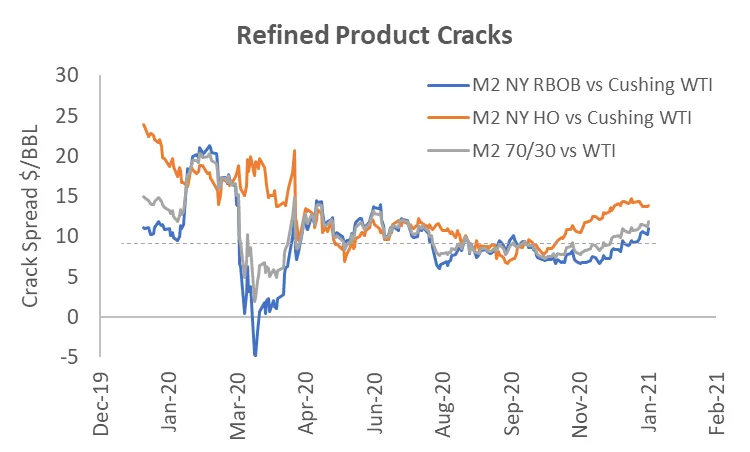
Figure 1: Refined product cracks against the WTI Cushing marker, second-month contract basis, not compensated for RVO. The 70/30 crack is shown as a simple FCC margin marker. Pricing source: EIA weekly.
Applying simple, fixed product yield assumptions to these cracks gives an indicative FCC margin, which we track to stay current with the economic environment our customers plan and operate in. Figure 2 shows how the indicator has moved since the pandemic began.
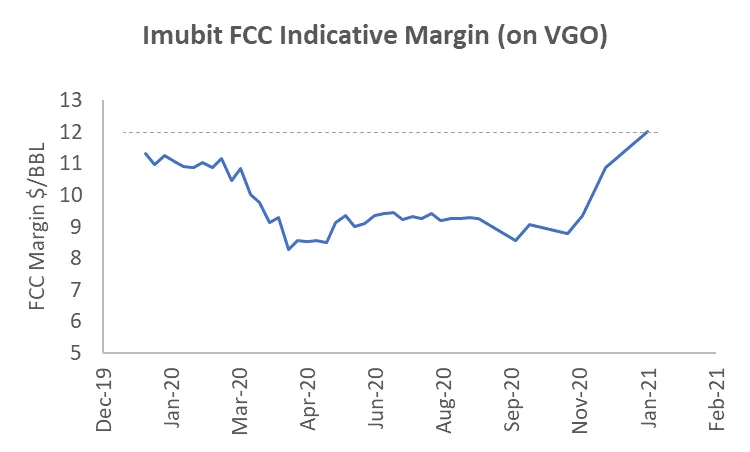
Figure 2: Imubit indicative FCC margin on wide-cut VGO, relatively high compared with most of 2020. The metric is calculated from publicly available market prices and our own assumptions on yields and on spreads for intermediate streams.
What the margin indicator leaves out
A single margin indicator shows the trend, but it flattens what has to happen on the unit every month, week, day and hour to earn that margin.
Monthly
Each month, planning and economics groups typically run the planning model, the FCC kinetic model or both to decide whether any imported feeds are attractive to buy, and the break-even prices traders should try to stay below. The same economic environment shapes crude selection and capacity utilization plans, which reach the FCC later, at runtime.
Weekly
As runtime approaches, the LP and kinetic models typically produce more tactical operating strategies. These reflect the site's needs in the gasoline and diesel blending pools, feeds already committed and other constraints. The method and quality of these plans, and how closely operators and engineers follow them, can make a large difference to site profitability over a year.
At this interval the plan may set a specific riser or reactor temperature, usually together with a feed or product goal. A typical FCC run plan might read: run 90 KBD of feed, maximizing conversion to fill the alkylation unit. That plan sets no temperature target. It sets a clear economic goal and leaves operations to decide how best to reach it. Other sites run to maximum or minimum conversion targets without a product limit, especially when cut back from maximum rates.
Daily and hourly
Board operators, process engineers and coordinators adjust FCC targets through the day based on tactical needs and current unit limitations. Preheat temperature, feed mix and catalyst additives can all be changed at this stage, and each can move unit profitability significantly. FCC yields interact strongly with regenerator temperature, preheat, riser temperature and feed type, so the effect of moving one depends on where the others sit.
That interaction makes maximizing volume gain and the other objectives in real time a hard problem for the operations and engineering team.
Where the margin is won
The best FCC profitability depends on planning and economics, engineering, operations and management working together, so that the monthly plan, the weekly run plan and the hourly moves at the board all point at the same economic objective. In between, the plan depends on recurring decisions, made every shift by different people with different information. For more on the unit itself, see FCC unit equipment layout, operating modes and performance.