By Allison Buenemann, Product Marketing Manager, Imubit
The American Fuel and Petrochemical Manufacturers (AFPM) published a white paper on the maintenance and adoption of AI-based advanced process control (APC). It was written by AFPM's Operational Planning, Controls and Automation Technologies (OPCAT) committee together with Imubit's Aaron Durke. You can read the full white paper. It covers the areas below.
What a new approach has to meet
Refineries and petrochemical plants contend with feedstock shifts, price volatility, and environmental and regulatory conditions that keep changing. Optimization and control built on linear or hybrid models has known shortcomings in that environment, and AI-based approaches are addressing them. To be adopted in production, though, an AI-based controller has to meet a higher bar. The paper describes what vendors have had to put in place:
- Change management procedures rigorous enough to make implementation safe
- Explainability and AutoML, so that people with a wide range of skills and roles can use the technology
- Processes for model evaluation and retraining, so the value holds over time
Together, these make a technically sophisticated solution understandable to the people who have to operate it.
How Deep Learning Process Control® works
Deep Learning Process Control® (DLPC®) uses several categories of AI to optimize complex industrial processes. It starts from historical plant data and builds neural network models that reflect the unit's actual process dynamics and constraints. That process model is then put through millions of simulations, in which reinforcement learning trains a controller to make optimal decisions across the range of scenarios the unit may encounter.
This approach handles model mismatch and adapts to real-world complexity where traditional technologies fall short, much as people learn to act on imperfect information. In closed loop, the controller writes to the plant's existing APC or DCS, with operators able to take over at any time.
Explainability and AutoML are conditions for adoption
When AI is used for closed-loop optimization and control, its users are not data scientists or machine-learning specialists. They are domain experts with a broad range of skills and programming familiarity: operators, process engineers, process control engineers and others in plant operations. A black-box model will never be enough for them. They need to trust the models they work with, and rightly so, given the risks of the environments they operate in.
AI providers in refining are opening up the black box with explainability and AutoML, so that the people who use model outputs can see what decisions the model will make in different scenarios, and why. Some of the most effective forms are interactive data visualizations. Users can run what-if scenarios to test the model's response to changes in disturbance and manipulated variables. These tools confirm nonlinear dynamics the team already expects, such as the gain flip that occurs as an FCC moves from under-cracking to over-cracking (Figure 1). Sometimes they uncover new dynamics that prompt teams to investigate, collaborate and learn together.
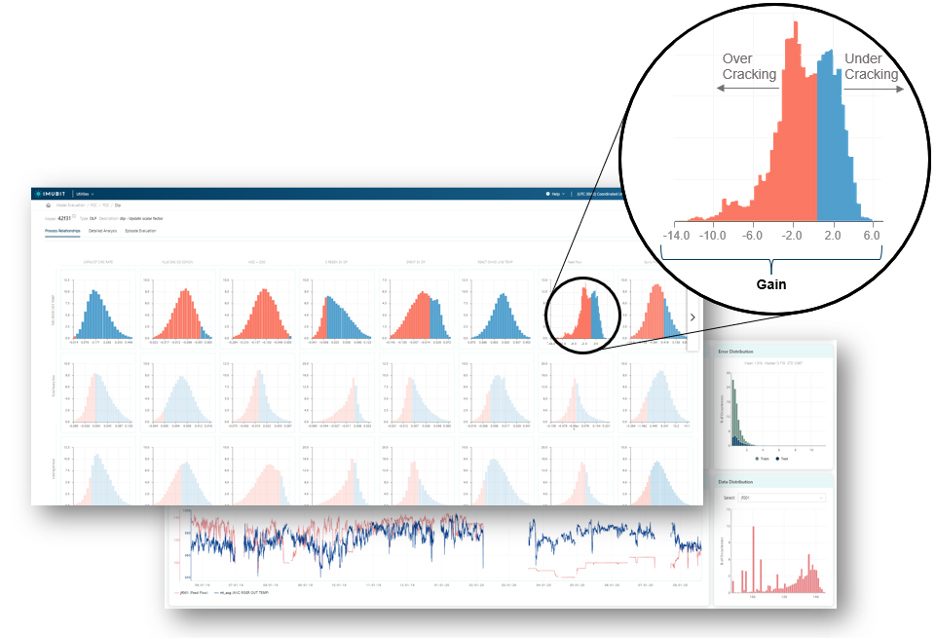
Figure 1. Interactive gain histograms are an explainability feature of DLPC® Explorer, Imubit's model evaluation tool. The callout shows a gain that changes sign between over-cracking and under-cracking.
Explainability builds trust by making model decisions transparent and interpretable. AutoML lets domain experts build and tune models without a data science background. In the Imubit Platform, that is the role of DLPC® Builder, where process engineers build models with no Python and no machine-learning background. Shared tools also give operations, process engineering, control and planning one view of the process, the controls, reliability and market economics.
DLPC® combines these techniques to bring AI into closed-loop control of complex units, on top of the APC and DCS already in place. For the full discussion of adoption and maintenance, download the AFPM white paper.