Chemical plants generate large volumes of sensor data across reactors, columns and heat exchangers, yet most of it never influences a control decision. Operators manage competing constraints by hand and rely on conservative setpoints that protect against the worst case rather than optimizing for current conditions.
The gap between available data and actual optimization is where chemical plants lose margin. Industrial AI narrows it by turning process data into control actions in reactor optimization, quality consistency and energy management.
Where AI creates value in chemical plants
Chemical manufacturing involves tightly coupled variables. Reactor temperature affects conversion, conversion sets the load on downstream separation, and separation load drives energy use across the system. Small improvements in how these variables are managed together add up quickly.
Reactor and process optimization
Reactor and process optimization is where most of the value sits. Models trained on operating history learn the nonlinear relationships among feed composition, catalyst condition and product yield that the linear models inside conventional advanced process control do not capture. When catalyst activity declines or feed quality shifts, these models adapt instead of falling back to a conservative operating envelope.
Real-time quality prediction
Every chemical plant lives with the lag between production and laboratory confirmation. Hours can pass between taking a sample and getting the result, and if conditions have drifted, off-spec product accumulates during that window.
Inferential models predict quality continuously from process variables, so corrections happen before off-spec material reaches downstream storage. The models that matter most hold their accuracy through grade transitions, feed changes and startups, where steady-state assumptions break down.
Energy, in the context of production
Energy is one of the largest operating costs in chemical manufacturing, and larger still in energy-intensive segments such as commodity chemicals. Optimizing steam systems, fired heaters and distillation energy within the plant's production targets can deliver real savings.
Cutting energy at the expense of throughput or quality creates no net value, so effective applications treat energy as one variable among many, tied to current production economics and emissions targets.
Why many chemical AI projects stall
The chemical industry has been a cautious adopter of AI, and the reasons are mostly structural.
Models built on design conditions lose accuracy
Many applications rely on physics-based models that assume idealized conditions. First-principles equations describe how a reactor should behave at design specifications. They struggle when actual behavior drifts with catalyst aging, fouling, heat exchanger degradation or feedstock variability. The gap between modeled and real behavior widens as the unit runs, and it erodes the accuracy that justified the original investment.
Unit-by-unit optimization creates blind spots
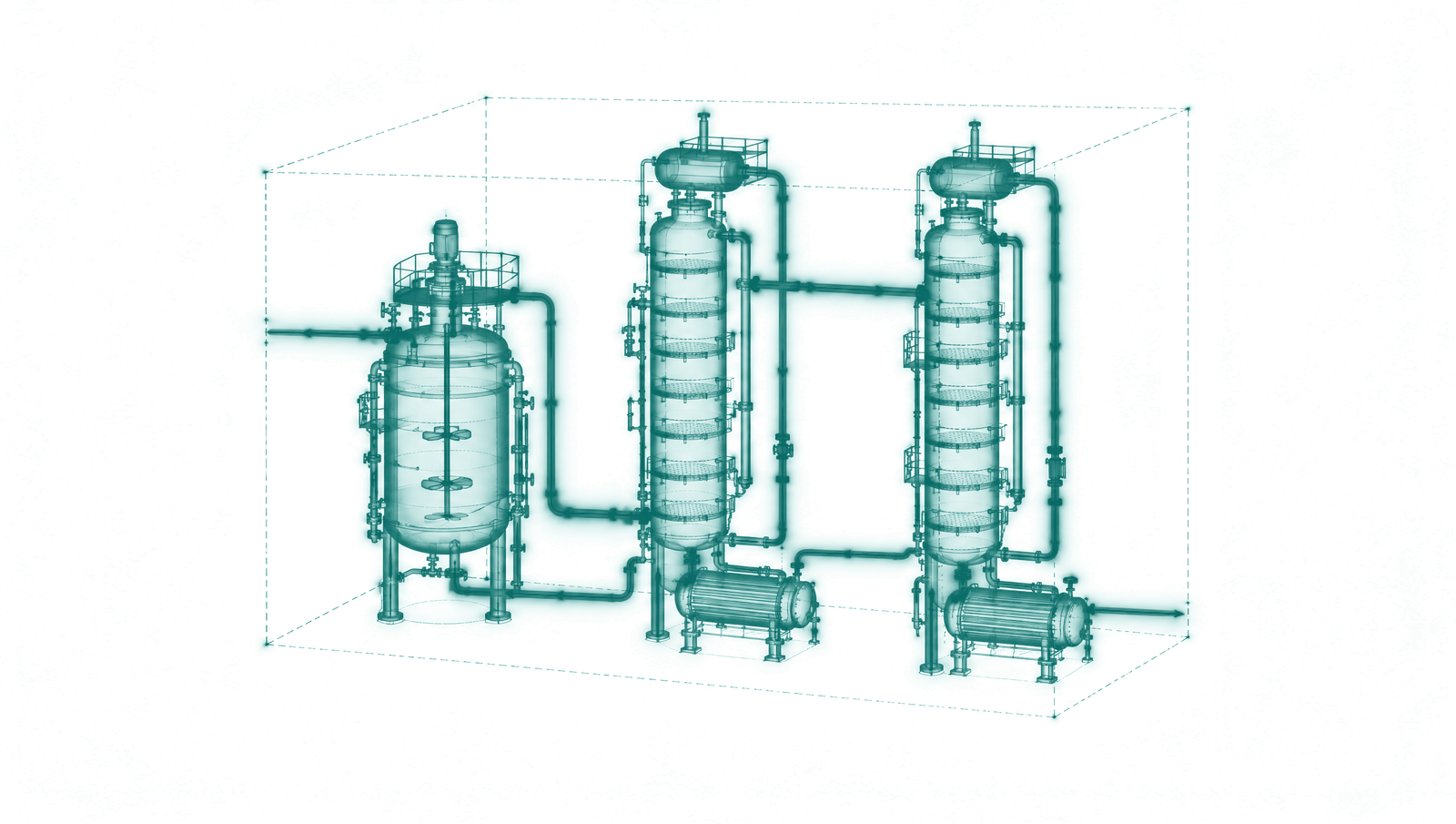
When each reactor, column and heat exchanger is optimized on its own, upstream changes can overwhelm downstream equipment while capacity elsewhere sits idle.
A reactor pushed to maximum conversion can make more byproducts and change the composition and heat load the separation train receives. The columns respond with more reflux and reboiler steam, energy use rises, and none of these controllers knows what the others are doing. A margin gain in one unit routinely creates a constraint in another.
Operator trust decides adoption
Workforce resistance is often the hardest barrier. Operators responsible for plant safety and product quality will not act on recommendations from systems they do not understand. When results come from opaque calculations, experienced operators learn to work around the system rather than with it, however sophisticated it is.
What separates applications that deliver
The plants getting sustained value from AI have a few things in common, and they have more to do with approach than with technology.
Learning from the plant's own data
Instead of starting from idealized equations and calibrating them to plant data, effective applications train models on actual operating history to capture real dynamics directly. Physics guides the model structure, and the plant's own data trains the parameters.
This matters because the compensating strategies experienced operators develop over years, such as the workarounds for fouled exchangers or degraded catalyst, are embedded in the operating record. Models that learn from that history capture behavior a first-principles simulator cannot represent. Because they keep learning from live data, they hold their accuracy through the equipment aging and operating changes every chemical plant goes through.
Coordinating across the plant
Optimizing across the plant rather than unit by unit is equally important. Plantwide coordination balances material flows, sequences setpoint changes across units and resolves conflicting objectives within the limits operators set, instead of leaving operators to negotiate the trade-offs by hand. A model that sees reactor conditions, separation loads and energy use together can find opportunities that unit-level controllers cannot see.
Using the same model beyond real-time control
The same model can support what-if testing and process improvement analysis. Engineers can evaluate feed changes, a wider operating envelope or alternative catalysts in simulation, without production risk, and see the result of a change before they make it. That shortens improvement cycles that would otherwise need expensive physical trials.
From advisory mode to closed loop
How the model interacts with the control system matters as much as the model itself, and the plants that succeed do not start with full automation.
Advisory mode
In advisory mode, the system analyzes data and suggests setpoint changes that operators carry out by hand. Operators see the optimization opportunities, compare the recommendations with their own judgment and learn the model's logic. Advisory mode also supports what-if analysis of trade-offs, and it gives every crew the same recommendations, which narrows the differences between shifts. When the model keeps finding valid opportunities, or catches developing problems before operators notice them, confidence builds.
Training and knowledge transfer
The same models serve as training environments for developing operators. New hires can rehearse grade transitions, startups and upset responses in dynamic simulations built from actual unit data. With experienced staff retiring faster than replacements arrive, this addresses one of the industry's most pressing workforce constraints: institutional knowledge that lives in people rather than in systems.
From shared understanding to closed loop
Coordination starts when maintenance, operations and planning share one view of plant behavior. Instead of working from different assumptions about what a unit can do, teams align around a single model that reflects current conditions, equipment health and economic trade-offs. That changes how decisions are coordinated across functions that have traditionally optimized in isolation.
As confidence builds, plants extend the scope of closed-loop control. A controller that writes optimized setpoints to the DCS in real time captures value continuously. When feed quality shifts at 2 a.m., or a downstream unit reaches a constraint during a complex transition, the controller responds within the limits operators have set, without waiting for the next shift to notice, and operators see each move. Closed loop needs deeper integration with the control system, and in return it captures value in every hour of operation.
Frequently asked questions
Can industrial AI work with existing DCS and APC?
Yes. The model sits on top of the existing distributed control system and advanced process control and works through them. It reads process data from those systems and writes optimized setpoints through the established control infrastructure. Plants keep their existing control investment and add closed-loop capability one unit at a time.
What results can chemical plants expect from energy optimization?
Results depend on plant configuration, product mix and current operating efficiency. Applications that optimize energy within production objectives, rather than as an isolated variable, typically find opportunities in steam system balancing, fired heater efficiency and distillation energy intensity. Because energy use and Scope 1 emissions are directly linked, the same improvements often support decarbonization targets alongside economic ones.
How Imubit applies this
In chemicals and polymers, Imubit applies Map, Model and Control. Map traces plan-to-plant gaps in yield, quality and energy to the recurring decisions behind them. Model uses Deep Learning Process Control® (DLPC®) to learn a nonlinear dynamic model of each unit from its own history, guided by first principles, and process engineers build those models with no Python and no machine-learning background. Control takes the critical decisions to closed loop, writing setpoints to the existing APC and DCS, inside limits set by plant engineers. At one chemical manufacturer, modeling a critical unit with a dozen operating regimes led to a 0.5 to 1% increase in yield, reducing feed costs, across multiple sites.