Process industry leaders are under pressure to adopt AI. Vendor pitches arrive every day, each promising to change how the plant runs, and the team asked to evaluate them is usually the same team that keeps the plant running. Most leaders accept that AI can add value. Fewer know where to start, or whether they have the right people in place to make a project succeed.
Software is one of the lowest-cost ways to get more performance and margin out of a plant with its existing people, processes and equipment. The difficulty is telling a maintainable technology that holds its value over time from a rebrand of older methods. These three questions are a good place to start.
1. Is the technology what it claims to be?
This is usually the hardest question, so ask it first. Was the company founded on AI, or has it started to emphasize AI recently? If recently, has the company changed with it? Has it brought in AI expertise to build the product?
The company's make-up and its patents are good gauges of how new the offering is. It is easy to market statistics as AI and much harder to defend that claim under technical questions or in a demo. Ask about the technology. If the answer is that it is proprietary, ask for the name of the technologist.
Then ask how the model is built. Many hybrid solutions are appearing in industrial process optimization, where first-principles models have long been the standard. An AI layer built on top of a first-principles model inherits that model's assumptions. When the plant deviates from theory, the combined model can mismatch the plant or fail to converge. A model learned from the unit's own operating history, with first principles as a guide, follows the unit as it behaves in operation.
2. Can your engineers use it?
Who will use the solution, and what skills do they have? Will they be able to use it and, more important, will they understand it?
Until recently, applying AI required programming skill. No-code and low-code tools have taken programming out of the equation, so domain experts can build and work with models in a point-and-click environment. That matters in a plant, because the people who know each unit best are its process and control engineers.
If your engineers can use the tool, the next and most important question is whether they understand and trust it. Explainability has become a central topic in AI because the math is not transparent to every audience. Trust comes from knowing what a model will do in a given set of scenarios. Interfaces for what-if analysis, and for investigating the relationships the model has learned, give engineers that understanding. They should be able to see the result of a change before they make it.
3. Does it run in closed loop?
Will the solution analyze and advise, or analyze and act? Much of the difference in value captured by different AI solutions comes down to whether a person has to act on every recommendation for the value to be realized.
People remain central either way. The model is built on the expertise of the people who operate, analyze and improve the process. But when a model calls for moving 22 variables every five minutes to hold an economic or energy target, no operator can make those moves by hand at that frequency, however skilled.
Many AI tools on the market offer good multivariable insight and deliver it in an open-loop, advisory way. A complex model of a complex plant produces a complex optimization result, one that adjusts dozens of process variables together. That kind of optimization captures its value in closed loop, writing to the control system with operators able to take over at any time. ARC Advisory Group describes this as human on the loop: the AI calculates and executes, and the operator moves from manual controller to high-level supervisor.
How Imubit answers the three questions
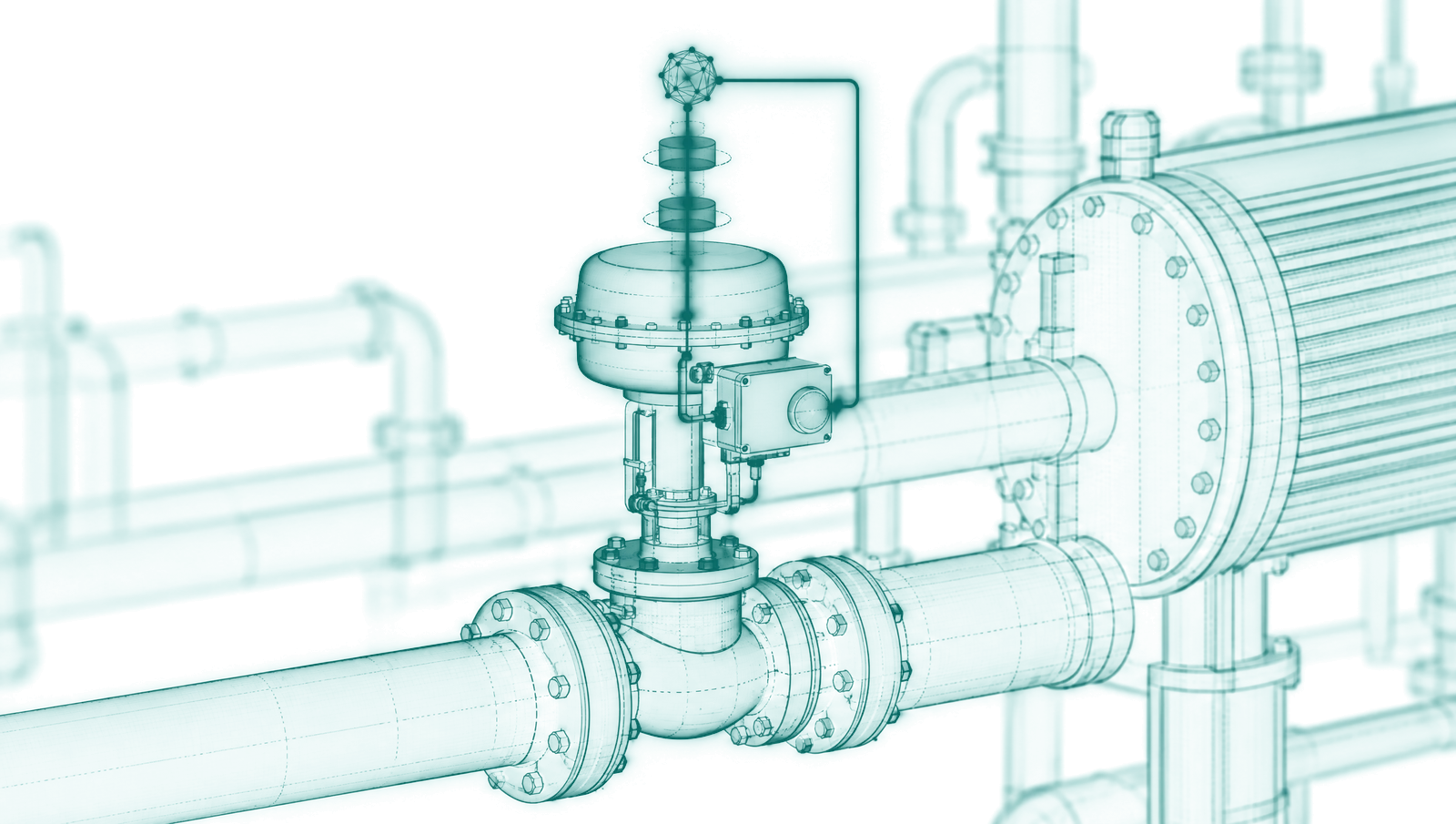
Founded 2016 and headquartered in Houston, Texas, Imubit holds 13 approved U.S. patents on core technology and process applications. Process engineers build Deep Learning Process Control® (DLPC®) models of their own units in DLPC® Builder, with no Python and no machine-learning background. The controllers run in closed loop on top of the plant's existing APC and DCS, inside limits set by plant engineers, in refining, chemicals and polymers, cement, and mining and minerals. Imubit has over 100 closed-loop controllers deployed worldwide, the largest install base in the industry.