By Greg White, Business Consulting Engineer, Imubit
In my years as an APC engineer, I spent many months building multivariable controller models from scratch. The work had three main steps: step testing, model simulation and model development. Simulation and development stayed inside the APC group. Step testing needed the operators, and it often frustrated both groups.
What a step test is for
Step testing is how APC engineers collect the data that represents the relationships between manipulated variables (MVs) and controlled variables (CVs) in a unit. Over a fixed window, usually about two weeks, operators make setpoint changes in the MVs at the request of the APC engineers, and the APC team measures the CV responses. For units whose targets rarely change, a step test is a way to gather process data across a range of values so that meaningful empirical relationships can be built.
Anyone who has worked in a refinery or another processing plant knows that two weeks of data is not a representative sample of how a unit will run over the five or so years of feed slate changes, yield shifts and fouling between major turnarounds. Ideally the controller is rebuilt after every turnaround. In practice that is rare, because the perceived return is low. A rebuild takes a lot of resources, and the goal will not be much different from before: maximize high-value products up to a constraint.
Most of that resource cost is APC engineering time. Process engineering, process safety, and sometimes instrumentation or reliability engineering also spend time, because their sign-off is usually required in the management of change (MOC) process. Those costs are small next to the larger one, which is moving the unit into a sub-optimal state for the sake of data collection.
The negotiation at the console
The APC engineer comes to the console wanting an MV move larger than normal process noise but not so large that it upsets the unit. The board operator wants a smooth shift: stable, predictable flows, temperatures and pressures, quality targets met, and an easy handoff to the relief. An engineer's experiment puts all of that at risk.
A typical exchange on a fractionator with a light cycle oil (LCO) draw goes like this. The engineer asks for a 5 degree increase in the overhead temperature. The operator objects. A move that large will back out the reflux, put the 95% point specifications on the products at risk, and could dry out the LCO tray, which can burn out the LCO pump. The engineer offers 3 degrees. The operations supervisor steps in, because hot work permits need signing and there is no time to heat up the column for a test. The engineer settles for 2 degrees.
The cycle repeats for every step change. The data from each test runs through the model simulation, and the outcome is a single gain for each MV and CV pair. It is easy to see why the relationship between operations and APC can be strained.
Learning from the plant's own history
Deep Learning Process Control® (DLPC®) takes a different approach to closed-loop optimization. In place of a step test, it learns from the years of historical process data the plant already holds. With good-quality data (see whether your data is ready for AI), a Deep Learning Predictor learns a nonlinear dynamic model of the unit from its own history, guided by first principles, and predicts how the unit will respond to a move.
Where a step test yields one simplified gain for each MV and CV pair, the model yields a distribution of gains, learned across the many combinations of MV, CV and disturbance variable (DV) values the unit has seen in operation and in simulation. The gain between two variables depends on where the unit is operating, and the distribution shows that dependence.
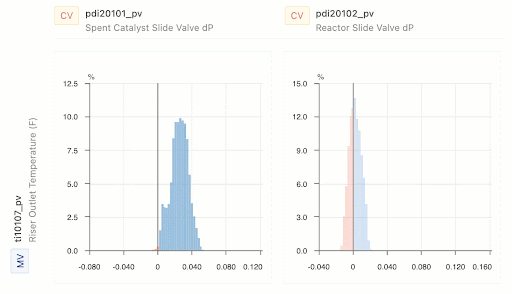
Figure 1. Learned gain distributions between pairs of variables, shown as interactive histograms.
A Deep Learning Controller, trained by reinforcement learning across millions of simulations on that model, learns the control policy for the unit. In closed loop it writes to the APC or DCS minute by minute, inside limits set by plant engineers, and drives the unit toward its constraints while respecting them. With no step test to negotiate, the main source of friction between operations and the APC team goes away, and both groups work toward the same operating targets.
Imubit applies the same approach across refining, chemicals and polymers, cement, and mining and minerals.