By Allison Buenemann, Product Marketing Manager, Imubit
It is hard to say which term got more attention at the 2025 ARC Industry Forum, "open" or "AI". Going by session titles on the agenda, AI came out ahead, with 16 mentions. Our view is that an increasingly open industrial software landscape is giving AI room to add more value in the use cases that matter to a plant. One session showed this well. A U.S. refiner presented its closed-loop work on a naphtha system, and a panel followed on what makes an AI project last. These are the highlights.
Closed-loop optimization of a naphtha system
The refiner's process controls supervisor described taking AI from a corporate directive to results. Support for AI projects at board level removed much of the inertia that new technology projects often meet. With that support in place, the team needed to match the right technology to the right problem and prove it out.
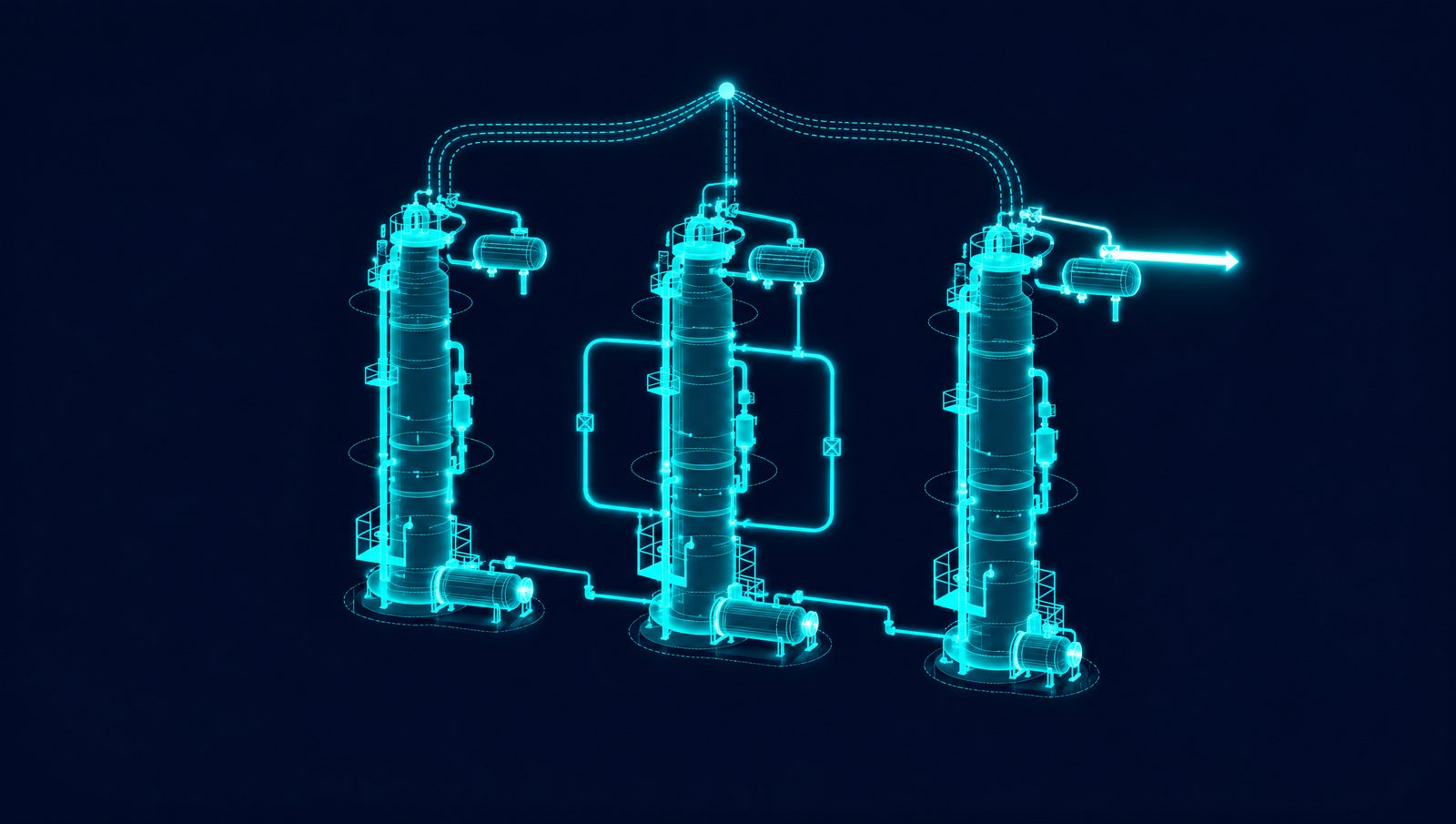
The naphtha system at one of the refiner's sites was a good candidate. The individual towers were controlled in different ways, and that variability created complex, nonlinear dynamics when the team tried to optimize the overall naphtha pool. The three towers were also split between two operations consoles, which added a layer of communication complexity. Imubit's Deep Learning Process Control® (DLPC®) fit the problem because it models the nonlinear behavior of the system and brings the optimization of all three towers onto one platform that the operators on both consoles share.
The controller has three objectives:
- Maximize total naphtha.
- Minimize the bypass around the system.
- Meet the economic target while reducing the variability in meeting it.
When all three are met, steam production is also minimized, which brings a carbon benefit.
Optimizing to these objectives has helped the refinery start to identify the bottlenecks in the field that stop it from pushing harder. The team now has a way to see the benefit of work such as valve trim replacements or reboiler cleanings, which it did not have before.
What makes an AI project successful and sustainable
The session closed with a panel of AI practitioners from the refiner and a second oil company, alongside Imubit and a consulting firm. An ARC Advisory Group analyst led the discussion through topics from project justification to safety and maintainability. Five lessons came out of it.
1. Ready your data
The refiner found that some variables, once seen as unimportant, had never been historized, so they were not available for modeling. Data storage is cheap, and as long as collecting a variable has no impact on process operations, it should be historized for future use. The second oil company stressed governance and employee accountability for data quality. Imubit Solution Manager John Milaszewski made the point that poor data quality today does not rule out a successful AI project: "A lot of what the implementation team at Imubit does in tandem with customers is defining the problem in the context of the information that's currently available and building the reward or objective function from there."
For more on this topic, read our post on making sure your data is ready for AI.
2. Ready your people
Imubit noted that at many sites the easier improvements have already been made, and the problems that remain are more complex. Solving them takes more capable technology, and people to champion it. The refiner agreed that powerful solutions need a strong organization behind them to get the most value from them. In its case, support from the board and from management, together with strong technology champions, has been central to its success. The second oil company was pleasantly surprised by how easy it was to find champions. People are eager to work on AI projects and see in them new opportunities for career and personal growth.
The consulting firm added that in innovation work you sometimes cannot prove the return on investment in advance, because you are doing something nobody in the industry has done before. In those cases, management's trust in the credibility of its technology champions is what moves a project forward.
3. Make it safe
Many people hear "AI", think of Skynet, and decide they would never let it take control of their plant. A requirement for the refiner was that the on-site model, the one connected to its control layers, does not learn online. John explained that Imubit is deliberate about this: "It's all learned offline. Then the model is presented to the customer, we agree on what it's learned, what it's going to do, alright it's locked in."
4. Make it trustworthy
Any form of AI can feel like a black box, so it matters to find ways to show what a model will do, through interaction, visualization and training. Imubit engineers work with customers to show how the model behaves across a range of situations, even when the math is complex and the model equation cannot be written out. For the refiner, it was also important to show that once the controller is online, it operates within the limits it has been given. If it starts to deviate, it turns off or holds at the upper or lower limit.
5. Make it sustainable
Both oil companies agreed that much of a technology project's success comes from choosing a good partner. You need support from your own organization, from technologists, leaders and managers, and you need technology partners who are invested in your success.
For the refiner's process controls supervisor, the job is to champion technology that gets the engineers on his team excited to build the next model. Technology that is enjoyable to use and draws people in, backed by a partner that monitors the system proactively, responds quickly and helps drive adoption, has been critical to his success.
Give your operators a golden batch day
A common theme across many presentations at the forum was the role of human operators. People will continue to play a large part in making technology deployments succeed, and no role matters more to adoption than the one that can turn the technology off.
John recalled his earlier work with a chemical producer. He described an operator's golden batch day as one where they came onto a unit that was on spec and lined out, kept it that way for the next 12 hours, and handed a lined-out, on-spec unit to their relief. Technology that can push a unit to its economic optimum without disrupting that golden batch day is technology that stays on and keeps generating value. Applied alongside the five lessons above, that principle puts an AI project well on the way to success.
Closed-loop control has to work that way in a running plant. DLPC® writes targets to the existing APC or DCS minute by minute, within the limits the site sets. ARC Advisory Group calls this the human on the loop: the AI calculates and executes, and the operator moves from manual controller to high-level supervisor.